
Garden Centre Association Competition Winners

Want the best? Here they are!
As you know, Life is a Garden is the marketing branch of The South African Nursery Association, known as SANA for short. To become a SANA member, garden centres and home stores must meet a series of criteria and evaluations set out by experienced committee members. SANA’s goal is to set an industry benchmark and maintain the standard of their world-class retailers.
GCA stands for the Garden Centre Association, striving to present a professional image of the horticultural industry and encourage professional business practices through a code of conduct.
Here are your top GCA Garden Centres in South Africa:
- Plant Paradise Garden Centre
- Eckards Garden Pavilion
- Stodels Nurseries Bellville
- Heckers Garden Centre
- Stodels Nurseries Menlo Park
- Concrete & Garden Creations
- Builders Warehouse PE
- Builders Express Robindale
- Builders Express Hillcrest
- Builders Express Northmead
To find your nearest award-winning GCA, visit our website at www.lifeisgarden.co.za and follow the Garden Centres tab on the top menu.

LIAG Press Clippings – February 2023

Life is a Garden received press coverage to the amount of R575 555,00 in the month of February. The below spreadsheet shows the total press coverage that Life is a Garden received in the month of February 2023.
To view the Life is a Garden – February “Redbook” actual press clippings, please click here: https://www.redbook.co.za/share/book/57d411838e3f3652cb0906f859b27ad8
Marketing Snapshot

Tenacious Texture Poster

Thrills, fills, and spills – Tenacious Texture Edition

Fern Fountain DIY

This month would not be complete without a hands-on gardening project that screams ‘touch me’! Enjoy Life is a Garden’s quick and easy fern fountain DIY that is guaranteed to give you all the good feels and of course, add a banging boost of texture to your space.

You will need
- Multiple hanging baskets and goodies to hang them (drill, cord/chain, nails, etc). The number of baskets depends on how many tiers you have space for.
- A high beam/pillar/railing in mind from which to suspend the fountain.


- Potting soil and compost
- Your chosen fabulous ferns

Assembling the fountain
- First, conceptualise how many tiers your space allows. The idea is that each basket hangs below the previous one. As your ferns grow, this will create a stunning fountain display as they spill over the edges and almost blend in with each layer of the fountain. We recommend having at least two tiers, about 30 cm apart.
- Once you have your spacing sorted, secure your chosen hanging material goodies to your beam/pillar/railing. We recommend a set up with hooks or easy links that can be removed if needed (for watering or relocating). In other words, avoid permanently securing the baskets to their chain/cord.
- Transplant your tenacious textures and be sure to add a good helping of potting soil and compost. You may also want to add a little liquid fertiliser to help reboot plants after transplant shock. Water well and admire for years!


Plant picks
Visit your GCA Garden Centre to see which ferns attract you most. Remember to check their sun requirements and expected growth size. This will also help you plan better. Our favourites include our indigenous leather leaf fern (Rumohra adiantiformis), tropical maidenhair fern (Adiantum spp.), and the variegated ribbon fern (Pteris spp.).
All-the-feels landscaping Industry Expert

March Topic: Tenacious texture
Theme: All-the-feels landscaping
Industry Expert: Jimie Malan
Garden Centre supplier: Malanseuns https://www.malanseuns.co.za/
Their stellar reputation and quality plants over the past 110 years in the industry, have put Malanseuns on top of the list as one of South Africa's best Garden Centre suppliers. Life is a Garden met with Jimie Malan to get the best advice on how to bring in bold texture into your garden this March. Come find out how to add movement, contrast, and sound to your backyard and reap all the feels before winter arrives!

1. We loved reading the origin story on your website and how Danie Malan founded your family business all the way back in 1913! Can you tell us a bit about your personal gardening journey and how you have come to fit into the Malanseuns Pleasure Plants story?
Since I can remember, I enjoyed being in the garden. You can basically say I was brought up by plants. Some of my fondest memories are walking with my late grandma through her garden. She taught me all about plants and shared so many lovely stories about her favourite flowers. The love for plants runs through the Malan family’s veins and I too realised that my absolute passion is plants! You can almost say we have green blood and not red.
It is truly a big honour for me, as the leader, to work with this amazing Malanseuns team. Every day is a new adventure with plants. To me, it is very fulfilling to see new growth and also to follow the process of a plant growing into something beautiful!
I always say that you can be an artist with plants, simply by using their many different colours, shapes and textures.


2. The Malanseuns brand is certainly a renowned one.
Tenacious Texture Botanical Boss

Texture in gardening is not only about the physical appearance of plants, although this is an essential element. It’s easy to create texture with bold spikey plants paired next to delicate and flowy flowers, for example. Let’s take this a step further! Life is a Garden invites you to come and explore the tenacity of specific mood-generating plants and accessories that extend a theme, create movement, and cultivate depth around the garden.
“Think of texture as the relationship between the physical appearance, colour, and growing habit of certain plants that together, create layers of atmosphere and dramatic diversity in the landscape”
– Life is a Garden

The Shire: Frolicky and friendly
Plant picks
1. For full sun, plant trays of dianthus ‘Dash’ and ‘Bouquet purple’, along with petunia ‘African sunset’, and alyssum. These will add dainty charm in shades of purple, pink, plum, white, and orange-peach throughout the cooler months. Mini pots at the tea table, anyone?
2. Canterbury bells (Campanula medium) like semi-shade to full sun. Their fairytale-like dangling bell blooms will dance cheerfully in the breeze, adding movement and a whimsical feel. They reach around 60 cm in height and are frost-hardy.
3. The white stinkwood (Celtis africana) is loved for its sculptural shape. This stunning indigenous tree also attracts birds, creating a sweet soundscape to your Shire. Plant this tree for the perfect picnic spot and enjoy its flowers in spring. In winter, you can look forward to its illuminating bark that turns white like the wizard’s beard!


Accompanying accessories: log seaters, driftwood and moss, river stones, water features, birdbaths and bird feeders, chimes in trees, bark mulch, mosaic pots, fairy lights over arches, floating tea candles in the pool, hammocks, and raised, wooden edible beds.
Top tip: Avoid planting the same seedlings into the same beds every year as this can deplete the soil of nutrients that lead to fungal diseases.
The Autumn Harvest

It’s Autumn, and probably the last opportunity to soak up a lovely warm-ish day in South Africa before the winter chill sets in. Why not arrange some outdoor time on your patio with friends and family and surprise them by preparing some dishes, almost exclusively from your garden? Get your preserve recipes ready and let’s fill some bags with produce to share with those in need.

Pick me
A tasty host of herbs to be picked now include thyme, parsley, marjoram, and mint. Veggies like squash, zucchini, eggplants, peppers, chillies and, beetroot are also ready for the lunch buffet. Juicy fruit such as melon and tomato will be coming to an end now as well.


Harvesting tips
- Prolong your lettuce harvest by only picking the larger, outer leaves each time, allowing the inner leaves to keep growing.


- Tomatoes are ready to be picked when they’re uniformly red – just before they soften. Spray preventatively against various fungal diseases.


- Lemons, depending on variety and care should be available to harvest pretty much all year round. Keep your tree well-watered, prune when necessary and protect it from pests to keep your bounty flowing.


- Peppers are a Catch-22 harvest. If you want volume you should pick them frequently and before they mature since they’ll keep trying to produce viable seed but if it is flavour you’re after you need to let them reach maturity before harvesting knowing you’ll have less but tastier fruit.


Preserve your bounty
Fresh produce has a limited shelf life but that doesn’t mean you can’t enjoy your harvest for longer. Fill jars with homemade pasta sauces, relishes, and pickles that can be enjoyed for months after you’ve harvested your vegetables. There are some stunning preserve recopies out there, not to mention fire ciders and other health conics you can create.
Top 6 texture plants for the patio Tenacious texture
 Here are Life is a Garden’s top 6 plant picks for adding tenacious texture to the patio. As we approach autumn, now’s a great time to start planning your container boldness.
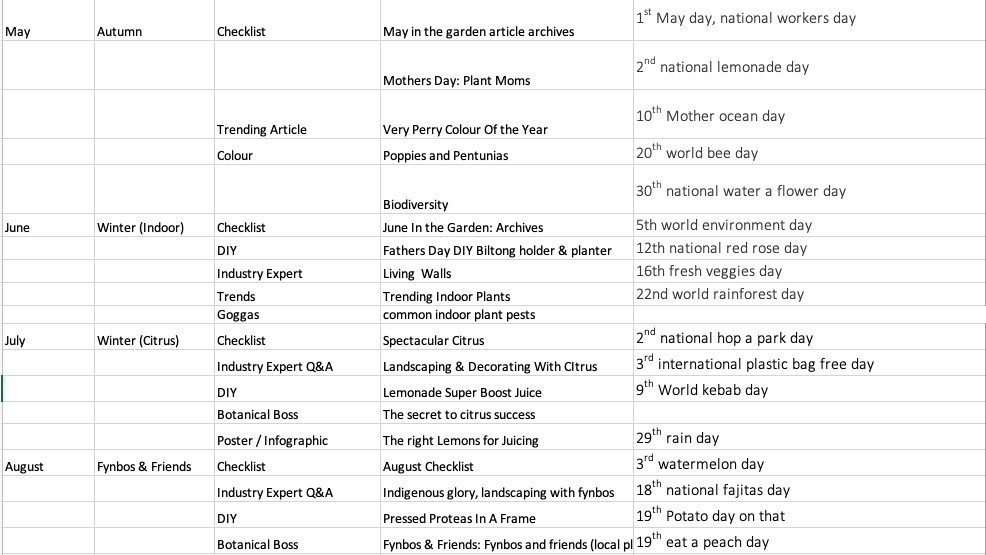
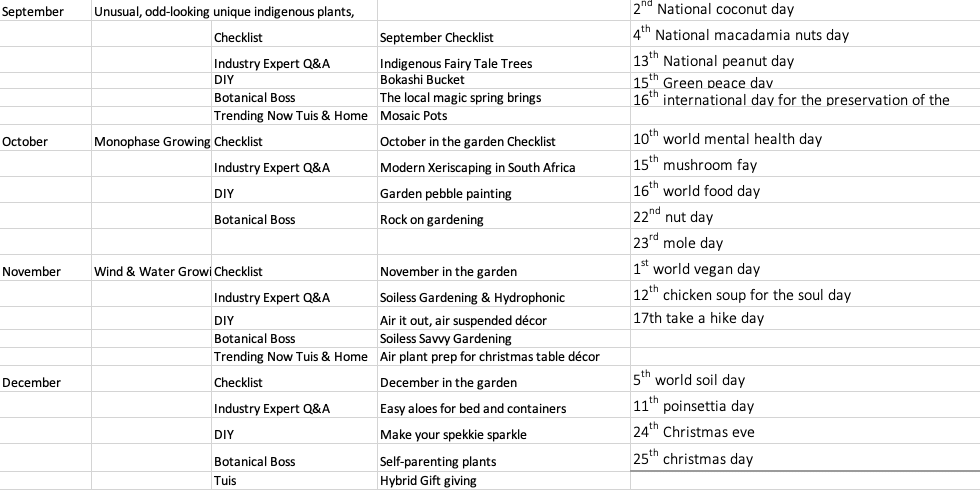
 Life is a Garden Plan 2023 (January – December)

A spreadsheet showing the plan and content themes for Life is a Garden for January through to December.





Life is a Garden Plan 2022 (January – December)

A spreadsheet showing the plan and content themes for Life is a Garden for January through to December.
LIAG Press Clippings – January 2023

Life is a Garden received press coverage to the amount of R1 227 485,08 in the month of January. The below spreadsheet shows the total press coverage that Life is a Garden received in the month of January 2023.
To view the Life is a Garden – January “Redbook” actual press clippings, please click here: https://www.redbook.co.za/share/book/947719f365d925437bed9eca2c3939ae
Marketing Snapshot

What is a GCA and why should you visit one?

What is a GCA and why should you visit one?
Come and learn about the fabulous benefits of our quality-approved garden centres and what makes them stand out.
- As you know, Life is a Garden is the marketing branch of The South African Nursery Association, known as SANA for short. To become a SANA member, garden centres and home stores must meet a series of criteria and evaluations set out by experienced committee members. SANA’s goal is to set an industry benchmark and maintain the standard of their world-class retailers.
- GCA stands for the Garden Centre Association, striving to present a professional image of the horticultural industry and encourage professional business practices through a code of conduct. You can identify a GCA by the green sign in the front of the store, or even better, you can access our nationwide directory via the website.
- Each year, there is also an exciting GCA competition that awards the Garden Centre of Excellence title to the best SA has to offer. Garden centres, home stores, and growers are judged according to their plants, products, service, and overall customer experience.
To find your nearest GCA, visit our website at www.lifeisgarden.co.za and follow the Garden Centres tab on the top menu.
The ferocious 4 – carnivorous plants to die for! Predator plant month

Come meet our ferocious four - your next hobby and likely, fantastic new obsession. Part plant and part pet, these fascinating predators with roots are perfect for beginners and will reward you with years of companionship, charm, and wonderment.

1. Venus flytrap:
Arguably the most popular predator. The ‘traps’ are two hinged lobes at the end of each leaf with hair-like trichomes that signal the snapping action. Digestive enzymes get to work as the plant absorbs a lovely nutritious soup.


2. Trumpet pitcher plant:
This cleaver funnel-like plant hunts using a pit-fall trap. Insects are attracted by a nectar-like secretion on the top of the leaves. The nectar is poisonous, sending intoxicated bodies tumbling down the funnel to be digested.


3. Sundew:
These sassy plants exude a sticky substance that attracts and then traps insects and other small prey. Their meal is quickly swallowed by a web of tiny tentacles and digested by enzymes within the plant stems and leaves.


4. Tropical pitcher:
More sack-like in appearance, they too attract insects using sweet intoxicating nectar. Prey slip on the rims of the plant, falling into a pool of poison. Soon, the insects drown inside the sticky acidic liquid, followed by digestion.


Top carnivorous plant tips
- Research your plant’s particular needs and respond to the changing external conditions.
- Predator plants thrive in nutrient-deficient soil with access to plenty of insects.
- When growing in containers, ensure pots have adequate drainage and are made of a material that does not adversely impact the PH and quality of the soil.
- Always use the correct potting medium. A blend of sphagnum peat and perlite is their favourite. Ask your GCA Garden Centre assistant for the best products to use.
Read more about predator plants here: botanical boss article
Predator plant month Botanical Boss

Predator plant month
What’s better than shark week? Predator plant month! Arguably one of the most charismatic collectables, carnivorous plants are a true spectacle in the garden. To help you become a predator botanical boss, Life is a Garden sat down with industry experts for the best advice on how to care for these exotic beauties. Your next exciting hobby and gardening project with the kids awaits!

FAQ’s with the Carnivore Queen from Jozi Carnivores.
How much sun does my plant need?
In general, carnivorous plants need plenty of sun as they are not good at photosynthesising (tropical pitcher plants, however, need dappled shade). The most common cause of plants not thriving is insufficient or incorrect sunlight.
Can I use any water?
Predator plants require water that is nutrient, mineral, and chlorine free. Rainwater, distilled water, or reverse osmosis water are perfect for your carnivores. Borehole water can also work but this depends on the quality of your particular water source. Mineral water is not suitable because it contains, well, minerals - and our carnivores like it rough.
How do I water my carnivorous plants?
Remember that most varieties are bog plants. You can recreate their natural environment at home by simply standing the plants in a shallow tray and watering from the bottom. The tropical pitcher plant, however, is the exception again as it is found in rainforests and needs to be watered from the top.
*Find out how to make your own bog garden here: Bog in a bucket DIY


Can I repot my predators in ordinary soil?
Normal garden soil, potting soil, and compost are too rich for carnivorous plants and will kill them quickly. Plants require an acidic, nutrient-deficient potting medium as they get most of their sustenance from the insects they catch and not through their root system via the soil.
Who is Life is a Garden?

Who is Life is a Garden?
Who is Life is a Garden? Stay tuned to find out what we are all about and let’s get to know each other better.
- Life is a Garden is the marketing branch of The South African Nursery Association. Our mission is to get all South Africans in the garden by equipping them with the knowledge they need to succeed.
- Our focus is on all levels of gardeners as well as container growing for the patio and balcony. We aim to inspire and educate by providing expert, trendy, multi-platform content that highlights wildlife sustainability, seasonal food growing, and indigenous beauty. We are passionate about the future generation of green fingers too and provide fun and creative DIY’s for the whole family to enjoy.
- Life is a Garden connects you to the topics of your interest and to experts in the industry. We provide easy access to quality-approved, independent garden centres and home stores, ensuring you get the best service, plant selection, and outdoor accessories.
Come check us out at www.lifeisgarden.co.za or on Facebook and Instagram at @lifeisagardensa.
What does Life is a Garden do for you?
What does Life is a Garden do for you?
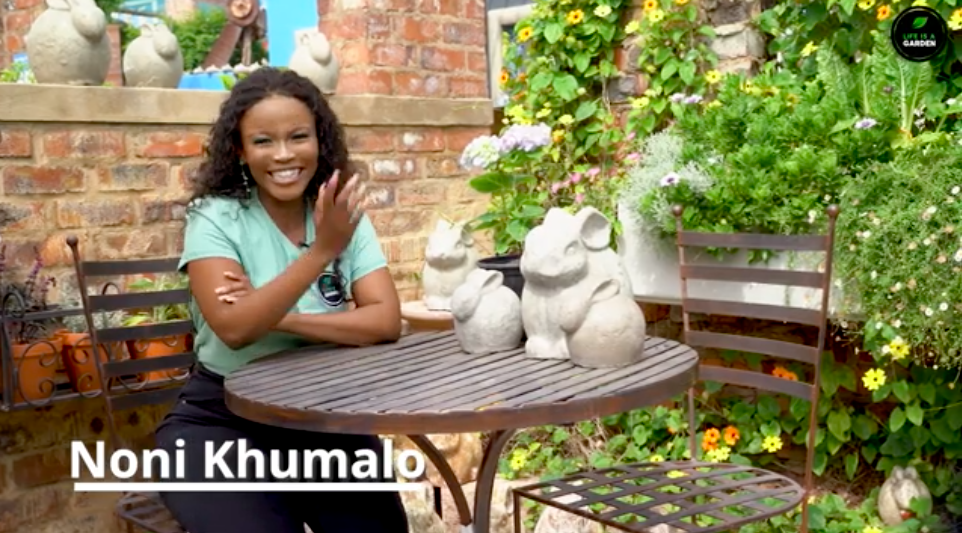
Welcome back! Today we’re unpacking what Life is a Garden has to offer and the benefits you gain from subscribing.
- As you can see, our website is loaded with greenspiration and provides you with a one-stop platform with access to seasonal grow guides for your region, our huge plant archives, trending now articles, DIY’s for the family, pest control solutions, gardening events and clubs in your area, and so much more! We even have a section where you can ask an expert and we’ll get back to you with professional advice.
- You will also find our Botanical Boss article for each month that explores the plants and trends for the season with help from relevant industry experts from around South Africa.
- In addition, we also provide podcasts for the gardener on the go, monthly newsletters to enrich your eco-wisdom, posters, how-to videos, and polls on our seasonal gardening group on Facebook.
- Our content covers a wide range of topics for both beginners and advanced gardeners with different growing goals.
Level up your game by subscribing to our newsletter via the website and join us on social media at @lifeisagardensa.
Green-ovate your bathroom Bathroom Plants and Garden Checklist

Green-ovate your bathroom with these moisture-loving, humidity-seeking plants.

Indoor bathroom beauties
Landscaping indoors is a great way to both extend and create a theme. In addition, the bathroom doubles as a sweet little greenhouse for all your favourite indoor lovelies. Consider the style of the plant to inspire your container shape and colour choice.
Tropical vibes:
Croton plants (Codiaeum variegatum) come in a large variety of foliage shapes and sizes as well as different colour variations. In general, the more variegated and colourful the croton plant, the more light it will need. They do not like the cold and will likely go through a shock period once brought home or moved. A tad fussy, but so worth it!


For good feng shui:
Sculptural and intriguing, the lucky bamboo (Dracaena sanderiana) is a good choice for beginners. They enjoy filtered sunlight and a drop of liquid fertilizer once a month. You can even grow this plant in a vase of pebbles and water, just be sure to refresh the water every week. In addition, stalks can be trained to grow in special twists and turns.
Striking and strange:
Guzmania flower bracts will captivate you all year round. As they tend to be top-heavy, place a stone at the bottom of containers. Plants prefer bright light, no direct sun, and an orchid mix soil base that is kept moist. Place them at eye level where you can enjoy their evergreen foliage and most unusual flowers.


Top tip: Remember to rotate your plants every two weeks for even, straight growth.
Top tip: Avoid fungal disease and ensure fresh air circulation by always airing out the bathroom after showering/bathing.
Try this:
Mount the staghorn fern (Platycerium bifurcatum) against a stunning piece of driftwood on a windowsill with indirect sun. As part of the epiphyte family, these Tillandsia (air plants) thrive by absorbing moisture through their leaves.
Bog in a bucket – your predator plant paradise DIY

Adopting a carnivorous plant is like having a pet, so if you’re looking to begin teaching kids responsibility – this species is a great way to start. Similarly, if you’re looking for a new hobby or an engaging, long-term gardening project, a bog garden offers years of thrills and companionship.
Did you know? The two types of trapping methods are grouped as either active or passive. Do some research to find out which style your little predator uses.
What’s a ‘bog’ anyway?
In the wild, one would find our predator plants thriving inside water-logged, nutrient-deficient soil and stagnant water. Over many years, this little ecosystem of decaying plant matter and limited water flow created thick layers of mushy muck – the perfect environment for these incredible predators. Carnivorous plants certainly challenge what we know about fertilisers and the importance of ‘good’ fresh water.
Your bog garden needs to mimic a lekker vrot swamp with 0 added nutrients as all the good stuff plants need comes from the insects they catch. It’s rather easy to create the perfect ‘bad’ environment for these plants when creating a bog in a bucked, which allows you full control over their living conditions AND external factors. When faced with hail, snow, frost, or other extreme weather, you’ll need to move your plant pets to safety.


You will need
1. Predator plants that have similar sun requirements and thrive from bottom watering as we’ll be replicating a marsh environment. We recommend homing these Thrilling Three together as they all enjoy full sun (at least 6 hours a day) and love wet feet.
- Sundew
- Venus flytrap
- Trumpet pitcher (NOT tropical pitcher as this guy needs dappled shade and top watering, so grow it separately)


- You will also need a very specific growing medium, which is a mixture of sphagnum peat and perlite, as well as reverse osmosis water or collected rainwater.
Incredible carnivores with roots Predator plant month

February’s topic: Predator plant month
Theme: Incredible carnivores with roots!
Industry expert: Renee Mendelow
Garden centre: Jozi Carnivores based in Midrand, Gauteng: www.jozicarnivores.co.za
If you have yet to explore the extraordinary world of predator plants, Jozi Carnivores has your next epic gardening adventure sorted! Located on a beautiful farm with horses and trees, this specialised Garden Centre is well worth the outing and offers fascination for the whole family to engage in. With thousands of exotic carnivorous beauties to choose from, our industry expert, Renee, has provided some invaluable information and advice on how to become the ultimate predator plant parent. Come dig in, if you dare!

1. Please tell us how your carnivore plant journey began and what made you fall in love with this most unusual species?
I discovered carnivorous plants at a time when I had three children in primary school. We were going to so many children’s birthday parties and spending so much money on gifts that were mostly about packaging and plastic. It made me feel sad. Around that time, I spotted a little Venus flytrap in a nursery and bought it for my daughter who shared my love of nature. She adored her Venus flytrap but a day or two later she emerged looking sad and worried. “It’s my Venus flytrap” she declared, “It’s bored and lonely and just sits around all day waiting for something to happen”. We clearly had a problem on our hands, so we decided to find a friend for the lonely plant.
We trawled the nurseries but found none. We then searched the internet and found a carnivorous grower in Cape Town. I was then exposed to the incredible world of carnivorous plants and discovered the fascinating variety available. I realised quickly that predator plants serve as an excellent educational, organic gift for children that also taught positive values such as caring for a living thing.
Predator plants for killer impact Predator plant month

Come meet our ferocious four - your next hobby and likely, fantastic new obsession. Part plant and part pet, these fascinating predators with roots are perfect for beginners and will reward you with years of companionship, charm, and wonderment.
