
Tomatoes

 There is just nothing to beat tomatoes in terms of taste, variety and satisfaction. In addition to this, they feature in just about every kind of cuisine, besides being a staple in salads and sandwiches. Tomatoes are easy to grow but they need more care than most other vegetables.
Any sign of insect activity or disease affecting tomatoes needs to be dealt with immediately, otherwise the harvest is affected. Indeterminate varieties need pinching and staking and even determinate varieties can be staked if space is limited. Besides that, however, no pampering is required. This basic guide for growing tomatoes includes some specific, very helpful tips.
Soil
Unlike other vegetables, tomatoes can be grown in the same place year after year, except if last season’s plants were diseased. Tomatoes like a soil which has lime or high calcium, otherwise the fruit itself may split. It is also recommended that you add agricultural lime before planting into your beds. Tomatoes are heavy feeders and lots of compost should be dug into the soil. Raised or mounded beds improve drainage and aeration.
Site and spacing
Tomatoes grow into substantial plants and should be spaced at least 60 to 80cm apart. Rows should be about 1m apart. They do best in positions that get full morning sun and afternoon shade. They can take more sun if there is good air movement otherwise they become susceptible to red spider mite.
Planting
Plant tomatoes ‘deeply’: when transplanting out of a smaller pot or from a seed tray, position the plant in the ground so that the lowest set of leaves is at soil level and press the soil down gently – this produces a sturdy plant. Planting deeply is particularly important if you plant tomatoes in pots – if the plant is not set deep enough, the roots seem to push themselves out of the potting soil.
Strawberries


Who can resist the juicy, sweet, bright fruit of a strawberry?
They are easy and rewarding to grow and will do well amongst other shrubs in a garden bed or in a pot. If you decided to plant your Strawberries in a garden bed, just ensure they are planted in slightly raised mounds to help with drainage.
Strawberries thrive in a well-drained, rich soil and are best in the full sun.
The fruit can be harvested from spring to summer.
Eastern Cape Stockists:
Floradale Nursery – Port Elizabeth
Builders Express East London
Builders Express – Jeffreys Bay
Builders Express – Newton Park
Builders Express – Uitenhage
Builders Warehouse – Port Elizabeth
Free State Stockists:
Alma Kwekery – Welkom
Bruwer Kwekery – Bloemfontein
Builders Warehouse Bloemfontein
Greenside Kwekery – Bloemfontein
Urth Garden Centre – Bloemfontein
Gauteng Stockists:
Colourful Splendour – Craighall Park
Garden Pavilion – Eckards
Garden Pavilion – Sunkist
Plant Paradise Garden Centre – Pretoria
Safari Tuinsentrum – Pretoria
Schaffler’s Nursery – Johannesburg
Limpopo Stockists:
Mpumalanga Stockists:
North West Stockists:
Western Cape Stockists:
Cape Garden – Joostenbergvlakte
Cape Garden – Somerset West
Cape Garden – Stellenbosch
Starke Ayres Garden Centre – Rosebank
Starke Ayres Garden Centre – West Coast Village
Stodels – Bellville
Stodels – Constantia
Stodels – Kenilworth
Stodels – Milnerton
Stodels – Somerset West
Builders Express – Kenilworth
Builders Express – Knysna
Builders Express – Stellenbosch
Builders Express – Willowbridge
Builders Warehouse – Cape Gate
Builders Warehouse – City
Builders Warehouse – Constantiaberg
Builders Warehouse – George
Builders Warehouse – Helderberg
Builders Warehouse – Table View
Builders Warehouse – Tygerberg
**Please note that not all stockists will have every plant featured**
Impatiens Sunpatiens


Easy to Plant. Exceptional Performance.
Garden success has never been simpler with easy-to-plant, easy-to-grow SunPatiens. The thicker petals and tough foliage of these impatiens mean they are less prone to disease, and their strong sturdy stems tolerate high heat and humidity, rain and adverse weather conditions.
- Easy to grow
- Thrives under heat, humidity, rain or shine
- Blooms nonstop
- Downy mildew resistant!
SunPatiens® are the first impatiens that actually thrive in full sun to part shade. They grow fast and fill in quickly thanks to their strong, durable root system. Many landscapers, home owners, growers and gardeners love the unstoppable flower power of SunPatiens. Follow these simple guidelines for optimal performance:
- Select a site with well-drained soil. Heavy, clay-based soils that retain excess moisture may limit aeration of the roots; amend this problem by adding organic matter to the soil. Bedding Plants are sensitive to soil compaction from heavy foot traffic so avoid stepping in the flower beds after transplanting.
- SunPatiens do well in various light exposures, from full sun to partial shade. SunPatiens may be planted under trees with high canopies or on the side of homes where they receive a few hours of direct morning sunshine. Variegated leaf types are great options for heavy shade locations due to the attractive foliage.
- During the first few weeks following transplanting it is important to water more frequently until the roots are well established. Until then, plants only have access to moisture in the initial soil ball and may be subject to wilting. SunPatiens will rebound quickly from wilt, however, with the addition of water. To avoid plant damage (leaf and flower burn), water early or late in the day when the plants are not under heat stress.
- A light mulch is beneficial in reducing watering frequency, but avoid mounding it up too close to the base of the plants as this could cause stem rot.
Fairy Bells (Dierama pendulum)
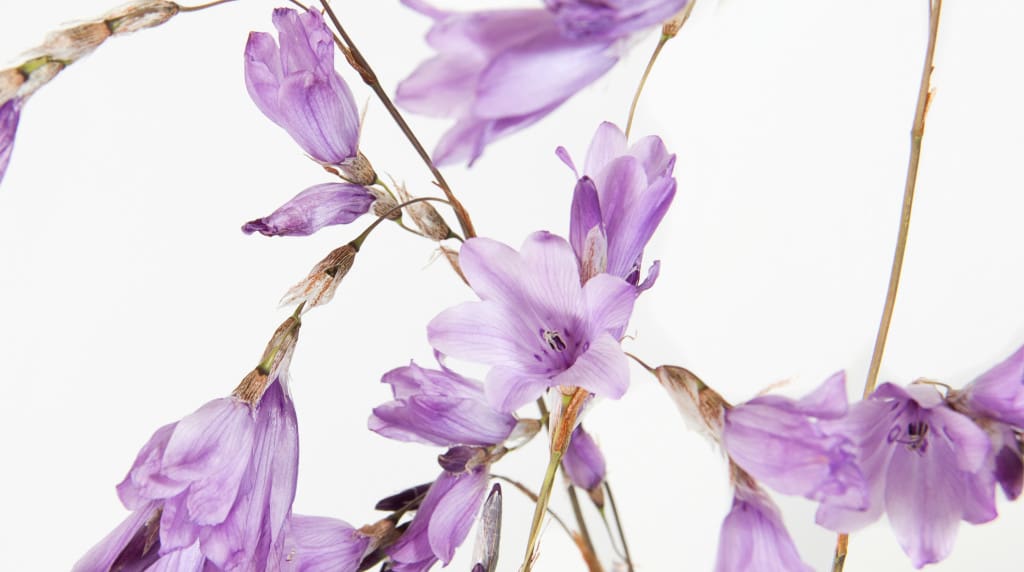
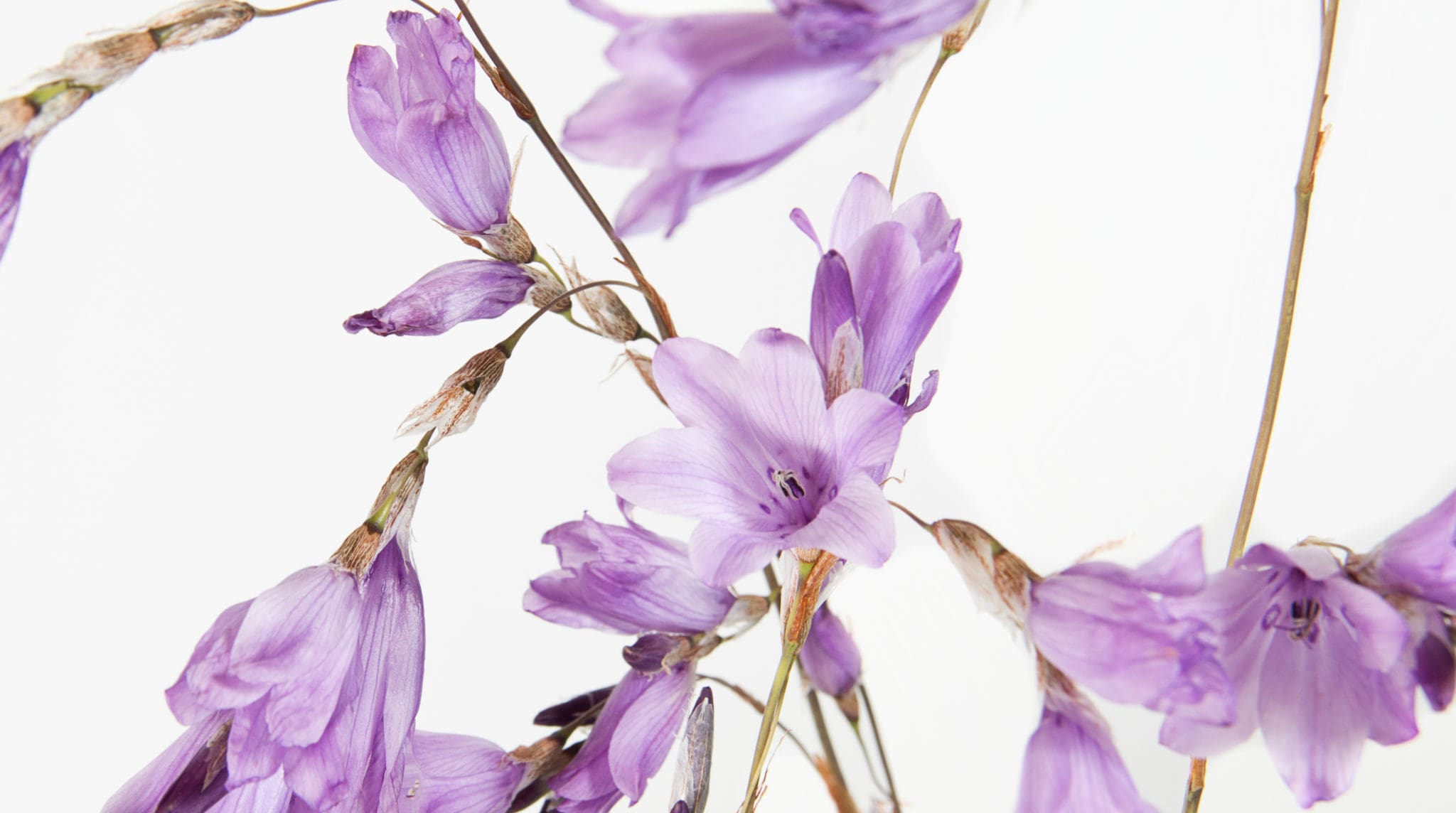
A wonderful juxtaposition occurs in the Eastern Cape veld from spring to early summer. Graceful wedding bells or African hairbells start peeking through the brown shades of veld, little treasure mounds of green and mauve that are a sure sign that warmer weather and picnics are on the way!
Dierama pendulum is an indigenous plant grown from corms and found in the Eastern Cape. They are commonly known as African hairbells, Fairy-Bells or Wand-flowers because of their elegant flowering and growth habit.
Dierama pendulum’s graceful wand-like flower stems arch above the leaves and then bear a series of drooping spikes with eye-catching, cup-shaped, flowers.The 5cm long flowers have a soft and delicate, pinkish-mauve colour with gracefully turned-back tips.
Dierama pendulum form evergreen, dense clumps with green, grass-like leaves up to a metre in height. It is best not to disturb the clumps for a good while after planting as dividing the plant earlier could result in it not flowering the next season. Once you have found a suitable position in your garden leave them for at least three flowering season to establish themselves well.
Should you feel the need to tidy up your African hairbells after a few seasons ,do not cut back the green leaves as this retards the growth and flowering simply remove the outer brown leaves by gentle tugging.
Dierama pendulum demand a sunny position in well-drained, composted soil, they will happily grow in boggy conditions but ensure the soil is not waterlogged.
Fairy-Bells enjoy plenty of moisture throughout spring, summer and autumn as this is their growing season. By providing less water in the winter months you will be sure to mimic the Eastern Cape winters and Dierama can then happily continue its dormant period. African hairbells are fairly drought resistant, but will not flower if there is insufficient water.
Calibrachoa


Hundreds and millions of bell shaped flowers on Calibrachoa make it a ‘must have’ trailing ground cover in gardens.
Calibrachoa look similar to Petunia’s and the flowers, while much smaller, look very alike. The plant forms small mounds of leaves with trailing stems that become covered in brightly coloured flowers. Calibrachoa are prolific bloomers from spring straight through to autumn. Pinching them back will ensure a more compact plant growth.
Calibrachoa is an easy gardening favourite to grow. Simply ensure they are in moist but well-drained, organically rich soil and planted in the full sun. Avoid soils with a very high pH. Calibrachoa will tolerate light shade but will not flower as profusely, however plants with some shade will survive longer into the hot summer months. The application of periodic fertilizer will encourage a longer and more prolific flowering period.
Look out for these varieties to brighten up your summer garden:
- Calibrachoa Calipetite Blue, Red and Rose. These plants have a higher PH tolerance then other varieties and forms balls of bright colour!
- Calibrachoa Callie Coral Pink, Light Blue, Scarlet Red, Sunny Yellow and Star Pink. These plants have a strong mounding habit and have unique markings on the petals
- Calibrachoa Conga Pink Kiss, Strawberry Sunburst. An abundance of bright blooms cover these well-branched, trailing plants. They are self-cleaning so they stay neat and tidy all season. Height approximatly 15 – 25 cm
- Calibrachoa Superbells Cherry star, Lemon slice, Pomegranate Punch, Coralberry Punch and Double Ruby. Are excellent summer performing annuals and are also self cleaning ( no deadheading )
Calibrachoas trailing habit makes it perfect for use in hanging baskets, containers or as a small area ground cover!
Eastern Cape Stockists:
Floradale Nursery – Port Elizabeth
Builders Express East London
Builders Express – Jeffreys Bay
Builders Express – Newton Park
Builders Express – Uitenhage
Builders Warehouse – Port Elizabeth
Free State Stockists:
Alma Kwekery – Welkom
Bruwer Kwekery – Bloemfontein
Builders Warehouse Bloemfontein
Greenside Kwekery – Bloemfontein
Urth Garden Centre – Bloemfontein
Gauteng Stockists:
Colourful Splendour – Craighall Park
Garden Pavilion – Eckards
Garden Pavilion – Sunkist
Plant Paradise Garden Centre – Pretoria
Safari Tuinsentrum – Pretoria
Schaffler’s Nursery – Johannesburg
Limpopo Stockists:
Mpumalanga Stockists:
North West Stockists:
Western Cape Stockists:
Cape Garden – Joostenbergvlakte
Cape Garden – Somerset West
Cape Garden – Stellenbosch
Starke Ayres Garden Centre – Rosebank
Starke Ayres Garden Centre – West Coast Village
Stodels – Bellville
Stodels – Constantia
Stodels – Kenilworth
Stodels – Milnerton
Stodels – Somerset West
Builders Express – Kenilworth
Builders Express – Knysna
Builders Express – Stellenbosch
Builders Express – Willowbridge
Builders Warehouse – Cape Gate
Builders Warehouse – City
Builders Warehouse – Constantiaberg
Builders Warehouse – George
Builders Warehouse – Helderberg
Builders Warehouse – Table View
Builders Warehouse – Tygerberg
**Please note that not all stockists will have every plant featured**
September in the Garden


Spring has sprung and nearly everything is in flower all over. If you’re short on colour, tools, pots, fertilisers, seeds and inspiration, relax! Your nearest garden centre stands at the ready to help you shop ‘til you drop. So, dig deep and plant to your heart’s content and your life will become a garden! One can simply not afford to miss out on the excitement and joy of spring and remember, what cannot supply instant gratification now, will not take too long to produce the fruits and flowers you need in summer. Come on, let’s jump to it!
This spring we are also celebrating life in more ways than one, by supporting The Sunflower Fund and the amazing work that they do in our community for patients that have been diagnosed with life-threatening blood disorders, such as leukaemia, and are in need of a stem cell transplant. Why not show your support for the organisation, by purchasing and making use of the Topes (Tubes of Hope) as sweatbands while planting an Arbour Day tree with the kids. They run the annual Sunflower Day (previously Bandana Day) and will this year be celebrating it on the 16th of September to raise funds for the cause. Topes are available from August at your nearest Pick ‘n Pay retailer and are available in a children’s size for only R20 (incl VAT) and an adult’s size for only R25 (incl VAT).
You too can make a difference and contribute to saving lives. Hope begins with you!
Bright and beautiful is in!
Your top flower priority is to fill sun-drenched spaces with indigenous gazanias which are in flower and available in seedling trays all over now. New hybrids of these spectacular plants appear every year, sporting huge flowers in stunning colour ranges. Keep on adding more colour with lots of daisy bushes, osteospermum, felicia, arctotis, and nemesia.
Indoor Plant of the Month for September: Schlumbergera
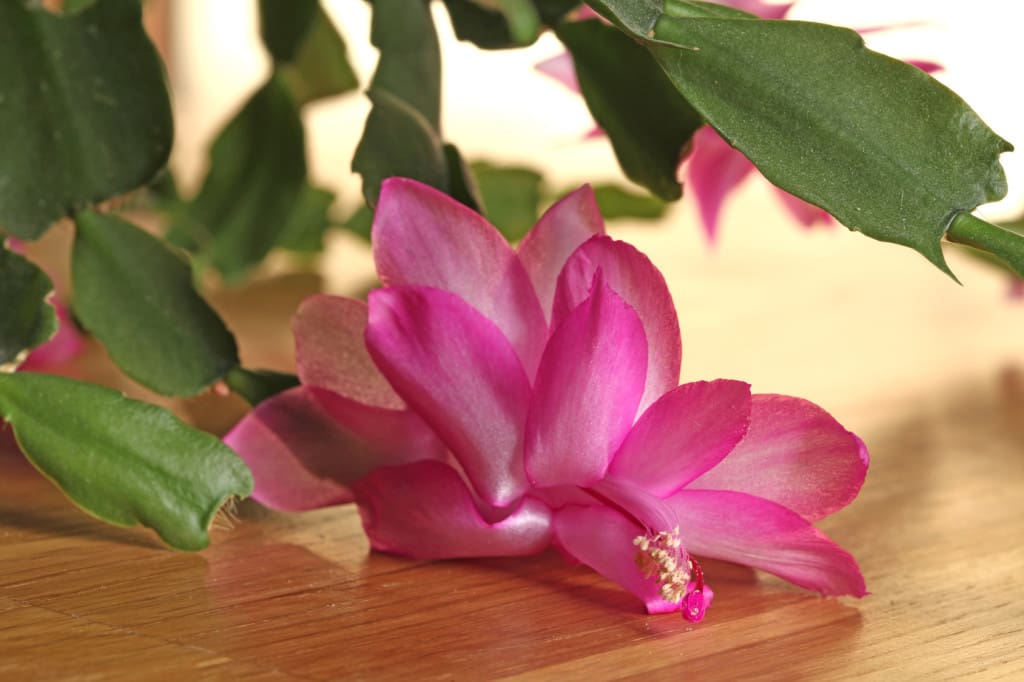
Christmas Cactus (Schlumbergera var.)
 Schlumbergera. It sounds like someone sneezing, yet it is the name of one of the most striking and surreal-looking indoor plants. The Christmas cactus is a small epiphytic (airplant) cactus, that produces a vivid, long lasting colour display of the most exquisite and unusual blooms. The common name ‘Christmas cactus’, is derived from the flowering time, which in the Northern Hemisphere, is over Christmas.
Despite the delicacy of the flowers, these small plants are surprisingly tough. They thrive both indoors and out – filling dull corners and requiring very little attention and care. The annual colour display typically results in them being moved into a premium display spot, where they will receive endless sighs and comments whilst in bloom.
The plant itself is most unusual and is sometimes also referred to as ‘The Crab Plant’. A quick glance at the plant and you’ll see why this name is so apt – the leaves are thick, squat and round, consisting of segments that radiate from the plant centre. When in flower, the blooms look exactly like the extension of a crab’s claw!
The Christmas cactus (scientifically called Schlumbergera truncata or Schlumbergera buckleyi) with their vibrant flowers, will leave a long-lasting impression in any house or office environment. The leaves are thick segments all in a long chain, radiating from the plant’s centre and have the ability to store water in times of drought. Schlumbergera is available in different colours, including white, pink, yellow, orange, red or purple.
Advice for the Christmas Cactus:
- Light: Bright light conditions, avoid direct sunlight.
- Water: Keep soil moist, but make sure that your plant does not sit in water, as this will lead to root and stem rot.
- Temperature and humidity: Ideal temperature would be between 14 and 21*C. Humidity: Moderate.
Top Plants Schedule – September 2016
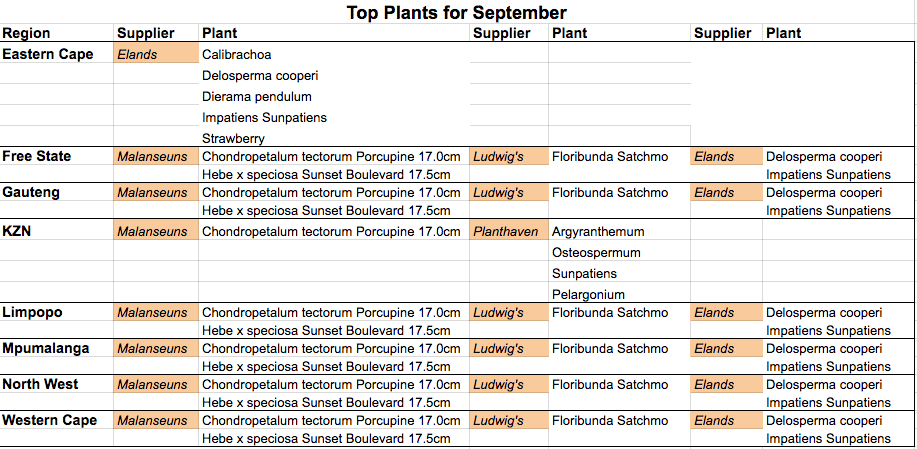
Spreadsheet showing retailers the top plants for September
Preview
Download here!
How to create and set up adverts for your business Facebook Page

A video describing how members can create and run adverts for their businesses on Facebook
Gardening at Leisure, Knysna
We are an informal and friendly group, and no matter what your gardening ability and gardening knowledge is, you can look forward to pleasant company, interesting guest speakers and a good tea at our meetings.
The Club was founded in 2003 by Sheena Maree and Denise Voysey. It meets on the first Friday morning of the month with the exception of January and July, when no meetings take place. The venues are at different localities, sometimes in members’ gardens or at places of interest. The Club’s mission is to promote the love of gardening, to cultivate gardening interest in its broadest sense, and to promote environmental responsibility.
Website: www.gardeningatleisure.co.za
Contact persons:
Chair: Denise Voysey
044 3841896
Treasurer: Kathy Michaelides
044 3840221
Web administrator: Esther Townsend
044 3820046
The Club’s Charity
Steenbok Nature Reserve is the main beneficiary.
Colour Explosion
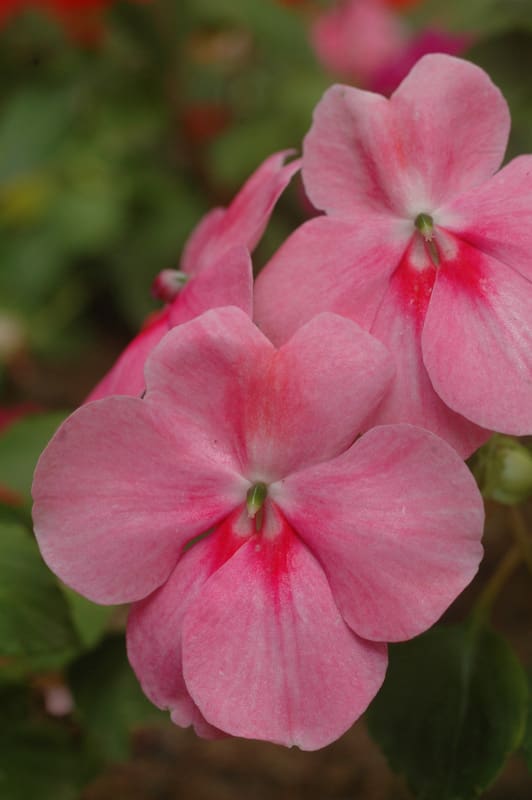
Impatiens – known to many as “Busy Lizzies” – are a vital ingredient to any summer garden. Few other plants offer such a mass of blooms for such a long period as these valiant little plants. There are lovely rich hues of reds and oranges for “hot” beds, gentle pastels to relax the eye and a pure white hybrid to add a sense of coolness on those hot summer’s days.
Couple them with Dahlias and your garden will simply be bursting with colour! In fact, the kaleidoscope of colours at your disposal will quite possibly leave you with a dilemma around choosing what you’re going to buy.
Impatiens
Impatiens will perform beautifully all summer long, impressing all passers-by. Once established, discerning gardeners the world have found them among the most carefree annuals in the garden.
Location:
Impatiens prefer growing in a lightly or partially shaded position, but they will tolerate periods of full sun during the day – they do very well in morning sun positions. Impatiens can be used extensively around patios and pool areas, along driveways and at entrances, in shady beds under trees or in borders shaded by wall, in-between shrubs and groundcovers. Window boxes, containers and the ever-popular hanging baskets also make for excellent homes.
Watering:
Like all seedlings, regular watering during the first two to three weeks is necessary. After the plants have established themselves, it is better to water thoroughly, less frequently. Remember that when it rains, plants under trees do not always get the benefit of the water because the trees act like an umbrella. Impatiens grown in sunnier positions will need more frequent watering.
Care:
Impatiens are “carefree” plants and deadheading is not necessary (i.e. removing spent blooms). Occasionally, in heavy shade or where the plants have been over-watered or overfed they can become leggy.
Sunsets and Honey
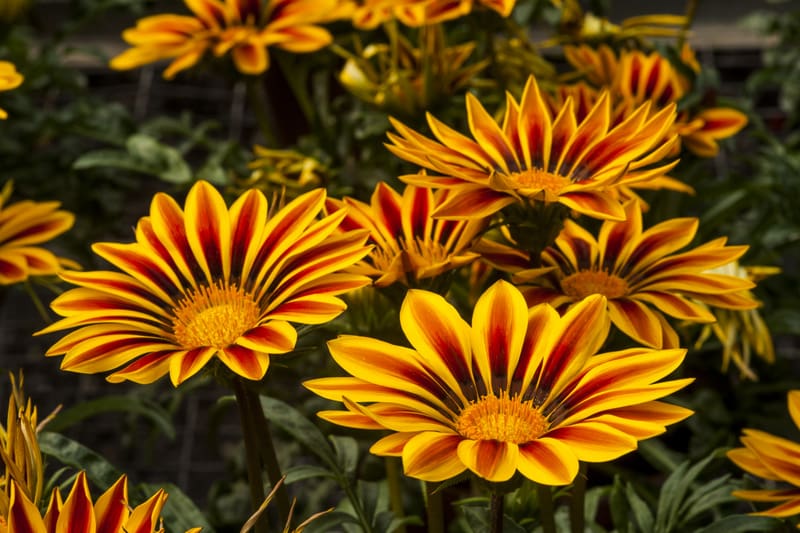
Our companions this month are reminiscent of two very special gifts from Mother Nature – sunsets and honey. Our indigenous Gazanias bloom in bursts of brilliant colours in the shades of a magnificent African sunset. Part of the Asteraceae, or daisy, family they have the common daisy shape, but the petals come in the most intricate colours and detail. Our other little gift, Alyssum, blooms in dainty umbrellas of multiple tiny flowers; scented sweetly with a very real honey-like fragrance. Perhaps the greatest gift of all is that neither of these beauties is particularly fussy, in fact they are pretty hardy and perfect for some of our harsher South African gardens where they do an excellent job of attracting birds, bees, butterflies and other ‘friendly’ insects.
Gazania
Our proudly South African national treasure even goes by the name ‘Treasure Flower’, and its richness in colours and varietals were clearly the inspiration for its Greek origination of ‘gaza’ meaning ‘riches’. These varietals include single, bi-coloured and even multi colours of orange, yellow, bronze and white that look like an artist has painted them. Petals do close on cloudy days and at dusk; some hybrids will open in low light.
Location:
Gazanias prefer full sun and thrive in poor soils and dry climates. Soil must be well-drained, not heavy or clay based. They can tolerate cold temperatures but not severe frost. Planted en masse, they make perfect ground covers in water scarce areas; they also work well in containers due to their trailing nature.
Watering:
When planting, water well, until the soil is completely moist. Once established, do not over water as this causes rotting as well as big clumps of leaves and no flowers. Being proudly South African, Gazanias can handle drought conditions.
Care:
Plant as soon as the danger of frost has passed.
How to plant seedlings Read more here
 Read more here
A1 Edibles poster – August Edible: Luscious Lettuce

Poster for edible gardening in August: Luscious Lettuce
Preview
A1 Indoor Plant Poster for August: Ferns (Nephrolepsis)

Poster for Indoor Plant of the Month for August – Ferns (Nephrolepsis)
Preview
A1 Water Wise Poster for August: Osteospermum

Eighth in a series of water wise plants to plant in the garden
Preview
Recycled kitchen teapot planter

Indoor Plant of the Month for August: Nephrolepsis (Fern)

After years out of the limelight, ferns are on their way back and are trending in 2021! Interior styles and fashions are moving away from colour and greenery is taking centre stage – this trend also extends to weddings and event planning, so rest assured – ferns are the next best thing!
Nephrolepsis is an evergreen fern native to humid forest and swamp areas throughout the world.
The Nephrolepsis is a popular house plant, often grown in containers and commonly found in hanging baskets. This dependable, easy-to- grow fern produces masses of long, narrow green leaves that arch and fall to create a soft, delicate indoor feature. They are particularly popular for use in bathrooms, where they thrive and tolerate the high humidity.
There are many different Nephrolepsis varieties, with varying green tones, leaf shapes and styles. These include Nephrolepsis Tuffy, Nephrolepsis Fluffy Ruffles, Nephrolepsis Boston Gold or Yellow Boston.
Nephrolepsis has recently been recognised amongst the top ‘air purifying’ plants. Recent studies have proven that indoor plants remove unwanted toxins from the air – and as such, ferns don’t only look good – they ‘do’ good too!
Nephrolepsis is one of the easiest ferns to grow indoors. Position in a bright light area without direct sunlight. (Ferns can tolerate lower light areas for a few weeks at a time, but should then be rotated to ensure best growth).
Normal room temperatures are suitable all year round, during summer and in extreme hot periods the plant will benefit from mist-spraying or stand the plant in water to increase humidity and re-create more natural growing conditions.
Regular watering is required. This may vary between 2 to 3 times a week in summer, right down to once a week in winter. Ensure the roots never dry out!!
Ferns can be grown in the garden and are popular as they establish quickly and spread easily to form a dense groundcover in shaded areas.
Tasty and healthy chow with salad leaves!


In yesteryear, the humble lettuce leaf was used mostly as a limp, green garnish next to a meaty dinner, or to keep one’s picnic sandwiches fresh. Now lettuce has morphed into a group of pretty salad varieties (some as decorative as garden flowers!), that have become part of our daily cuisine, because they contain few calories but have a high mineral and vitamin content.
It’s definitely worth growing your own salad greens, because most are quick and easy crops to grow and produce a harvest within a month or two. You can do it in a sunny garden bed, or as a portable ‘salad bar’ in a roomy wooden box or wide container.
The loose-leafed varieties are the most practical because you can harvest the individual leaves for up to three months before replanting. Others, like the butterhead or iceberg, are picked when the heads form so it’s best to sow seed at 3-4 weekly intervals to have a constant supply. If you are not up to seeding your own plants, relax! Nurseries have most worthwhile varieties in stock as seedlings in punnets, which you just have to plant out.
The basics:
● They need full sun, and in summertime it is best to grow them where they will receive morning sun only as they do not like excessive heat.
● Use a fertile, well-draining soil medium.
● Space seedlings about 30 cm apart to allow for good air circulation.
● Keep the soil evenly moist at all times – drought stress can cause a bitter taste.
● Fertilise monthly in the garden, and every two weeks in containers, with an organic water-soluble fertiliser rich in nitrogen.
Leafy herbs
Grow the following herbs with their distinctive tastes alongside lettuce varieties, as they are good companions in a salad bowl. They can be used in dressings and vinaigrettes or freshly picked, chopped and added to the other salad ingredients.
Parrot’s Beak (Lotus berthelotii)

The parrot’s Beak Lotus berthelotii is endemic to the beautiful Canary Islands; however these beautiful plants are thought to be almost extinct in the wild. They have now been officially classified as in danger of extinction; and listed in the National Catalogue of Endangered Species. Fortunately this species will survive due to cultivation and they are obtainable in Nurseries and Garden Centres countrywide.
Lotus berthelotii is an evergreen, trailing perennial that has slender branches covered in fine, silvery-grey, needle-like leaves. Its ‘carpet like’ habit makes it the perfect groundcover in a garden.
This Lotus can grow to a height of 20cm and needs to be planted in a sunny spot .It loves a well-drained composted soil, avoid soggy, clogged up soils which can lead to a very unhappy plant and root rot. They are remarkably forgiving plants and will be quiet content to only receive water when the soil is dry!
Lotus is extremely drought and heat tolerant and I have witnessed them personally in a coastal “holiday garden” where they only get annual attention, yet look beautiful.
Parrot’s Beak do not like long periods of rainfall as it can cause their foliage to drop however do not panic if this happens , if they have been planted in a well drained soil the water will soon dissipate and allow the plant to recover and dry out.
During late spring and early summer these Lotus explode in a mat of bright orange/red or yellow flowers amongst their contrasting foliage. These striking, unusual flowers are sickle-shaped with a prominent beak and look very much like a parrot’s beak or lobster’s claws… hence their name. They are supposedly shaped this way to aid pollination by birds.
When the new shoots appear on the plant, pinch out the tips, this will encourage Lotus berthelotii to send out side shoots and make an even thicker silvery carpet. Lotus plants are quiet happy to have a trim when they start looking scraggly.