
A1 Indoor Plant Poster (Now known as ‘Plant now’ or ‘House plant’) for November 2016: Chillies

A1 poster for the indoor plant of the month for November 2016 (Now known as ‘Plant now’ or ‘House plant’): Chillies
Preview
A1 Edibles poster – November 2016 Edible: Chives

Poster for edible gardening in November 2016: Chives
Preview
Clever Coconuts!
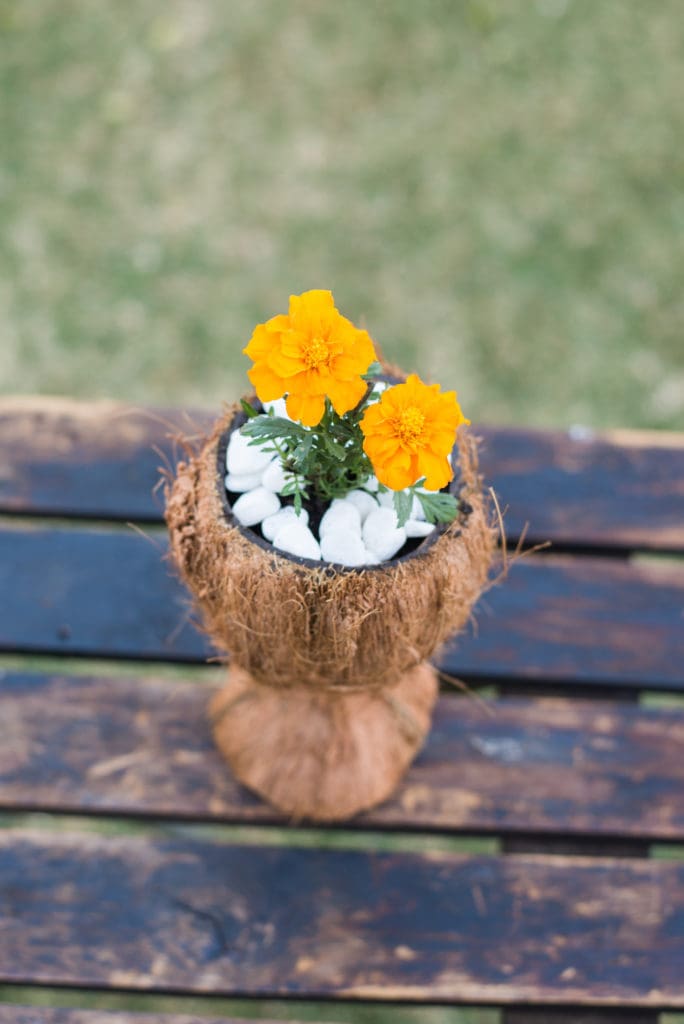
Let’s face it - anything looks better in a coconut shell. Put some juice and a straw in a coconut, and voilà, you have that tropical feeling already! The same applies with planting. Place a sunshiny spring plant into a coconut shell and you instantly create a fun, tropical springtime decoration.
Coconut shells are hardy objects, so they work well as pot plants - perfect for the beautiful South African spring weather.
This is such a fun (and tasty) project to do with the kiddies. Let them nibble on the coconut insides while you let the shell dry out. Get them involved in digging the fruit out and getting their hands dirty with the planting. They will have a ball!
What you will need:
- A coconut (preferably with a pointy end and a flat end on the opposite side)
- Weed barrier cloth
- Potting mix
- An old cup or spoon
- A seedling (we used marigolds)
- Glue
- White decorative stones


November in the Garden
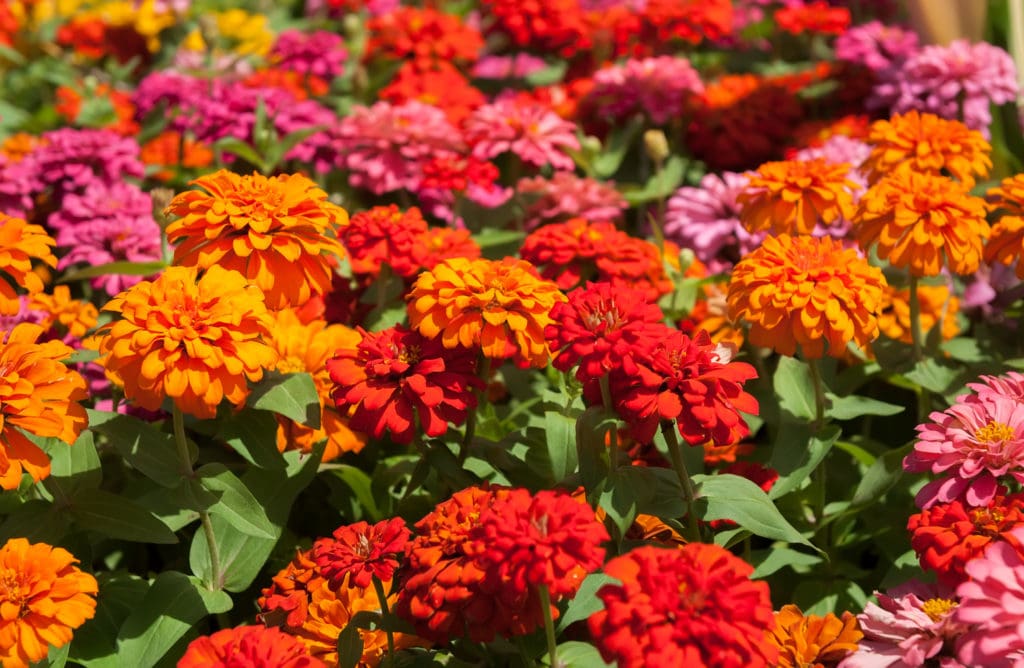
It’s summertime and life is, (or should be) a garden in bloom! Spend time this month to keep on feeding fast-growing plants and lawns, and adding lots of summer colour to your garden beds. Make it a priority to pretty up your entertainment area or patio with containers filled with beautiful specimens and flowering plants.
Flowers in season
 Marigolds are surely the most cheerful and easy to grow summer annuals. They love heat and full sun and do not require a lot of water. Fertilise them monthly to induce a mass of blooms.
There are different varieties of Marigolds and these are available in bright orange, yellow and red blooms. Visit your local garden centre to pick and choose the ones you love the most!
Use dwarf French Marigold varieties as companion plants in herb and veggie gardens to add colour to the foliage and to fend off bugs.
Other annual seedlings to add to your ‘colouring in’ checklist are New Guinea Impatiens, Busy Lizzie Impatiens and Begonias for shade, and Sunpatiens, Vincas, Dianthus, Petunias, Salvias, Zinnias, Gazanias, Gypsophila, Alyssum, Celosia, Calibrachoa, Verbena and Portulaca for sun.
Plant more of the all-time favourites like Lavenders, Cupheas, Gauras, Angelonias, Agapanthus and Alstroemerias (Inca lilies) – especially the dwarf and extremely prolific hybrids of the latter, which are perfect for container-growing too.
Dahlia tubers should go to ground now, for late-summer and autumn display.
Quick sowings include the always popular summer flowers like Cosmos, Zinnias, and Sunflowers which are sown directly into the garden.
Hunga busting

All pumpkin types are sown in November, but you can also sow seeds of French beans, climbing beans, mealies, sweetcorn, cucumbers, and melons in situ.
Plant seedlings of sweet peppers, chillies and tomatoes and remember to do follow-up planting of favourite cooking herbs such as sweet basil, coriander and parsley.
Dwarf Morning Glory Glory (Evolvulus ‘Blue My Mind’)
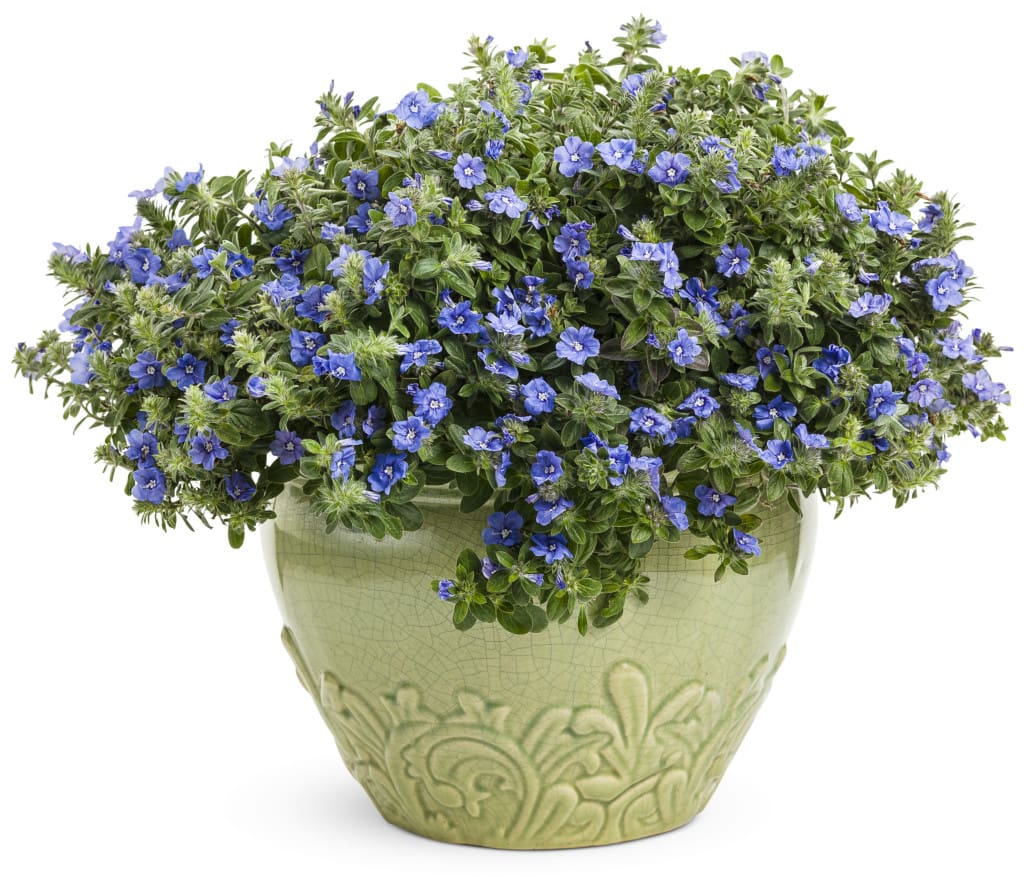

This plant will truly blow your mind with its true blue flowers and consistent flowering. It is perfect to use as a ground cover in the garden or in containers where it will form a mounding mat of blue flowers. Its leaves are silvery – green in colour and have a slight “fuzzy” feel to them.
Blue my Mind® loves hot weather in fact the hotter the better. It will perform best in a full sun position and is drought tolerant once established. However take note, as much as it loves the heat Evolvulus Blue my Mind needs to be protected from even light frost.
Be sure to water your Evolvulus well for several weeks during root establishment. While the plants can withstand drought conditions, growth and flowering are better with consistent moisture. A good dose of compost or slow release fertilizer will improve performance.
Blue is a wonderful cooling colour to have in a garden and with its long flowering period and no need for deadheading this plant is a maintenance free must have!
Eastern Cape Stockists:
Floradale Nursery – Port Elizabeth
Builders Express East London
Builders Express – Jeffreys Bay
Builders Express – Newton Park
Builders Express – Uitenhage
Builders Warehouse – Port Elizabeth
Free State Stockists:
Alma Kwekery – Welkom
Bruwer Kwekery – Bloemfontein
Builders Warehouse Bloemfontein
Greenside Kwekery – Bloemfontein
Urth Garden Centre – Bloemfontein
Gauteng Stockists:
Colourful Splendour – Craighall Park
Garden Pavilion – Eckards
Garden Pavilion – Sunkist
Plant Paradise Garden Centre – Pretoria
Schaffler’s Nursery – Johannesburg
Mpumalanga Stockists:
North West Stockists:
Western Cape Stockists:
Starke Ayres Garden Centre – West Coast Village
Stodels – Bellville
Stodels – Constantia
Stodels – Kenilworth
Stodels – Milnerton
Stodels – Somerset West
Builders Express – Knysna
Builders Warehouse – Cape Gate
Builders Warehouse – City
Builders Warehouse – Constantiaberg
Builders Warehouse – Table View
Builders Warehouse – Tygerberg
**Please note that not all stockists will have every plant featured**
Spekboom (Portulacaria afra)


Also known as Elephant’s food/the Pork bush, Portulacaria afra is a succulent shrub with small rounded leaves and a contrasting red stem.
It is an evergreen and performs best in a sunny position. Portulacaria is generally suited to all areas of SA but is not ideal in heavy frost areas.
‘Elephants food’ can comfortably reach a height of 3metres but is very easily trimmed into versatile hedges and screening plants.
Late winter and spring bring a flash of tiny pink flowers to this plant. These flowers are a rich form of nectar for insects. This, in turn, ensures your garden will be filled with birds.
Portulacaria afra is marvellous drought tolerant, a carbon sponge and an excellent soil binding plant to prevent soil erosion. All in all an easy to grow and very rewarding shrub!
Eastern Cape Stockists:
Floradale Nursery – Port Elizabeth
Builders Express East London
Builders Express – Jeffreys Bay
Builders Express – Newton Park
Builders Express – Uitenhage
Builders Warehouse – Port Elizabeth
Free State Stockists:
Alma Kwekery – Welkom
Bruwer Kwekery – Bloemfontein
Builders Warehouse Bloemfontein
Greenside Kwekery – Bloemfontein
Urth Garden Centre – Bloemfontein
Gauteng Stockists:
Colourful Splendour – Craighall Park
Garden Pavilion – Eckards
Garden Pavilion – Sunkist
Plant Paradise Garden Centre – Pretoria
Schaffler’s Nursery – Johannesburg
North West Stockists:
Western Cape Stockists:
Starke Ayres Garden Centre – Rosebank
Starke Ayres Garden Centre – West Coast Village
Stodels – Bellville
Stodels – Constantia
Stodels – Kenilworth
Stodels – Milnerton
Stodels – Somerset West
Builders Express – Knysna
Builders Warehouse – Cape Gate
Builders Warehouse – City
Builders Warehouse – Constantiaberg
Builders Warehouse – Table View
Builders Warehouse – Tygerberg
**Please note that not all stockists will have every plant featured**
Zinnia Zahara Sunburst


Zinnia Zahara have striking summer flowers and Sunburst™ tops this list with its striking orange and red bi colour flowers.
Zinnias generally have a mounded growth pattern with upright green foliage and make for great Christmas colour in a garden.
They must have a full sun position and once established are very drought and heat tolerant.
Dead heading of the spent flowers is essential to promote more flowers and a longer flowering period.
Zinnias are butterfly and bee magnets! They are perfect for containers or as bold front colour for your garden beds. Now is the perfect time to plant them for great Christmas season colour.
Eastern Cape Stockists:
Floradale Nursery – Port Elizabeth
Builders Express East London
Builders Express – Jeffreys Bay
Builders Express – Newton Park
Builders Express – Uitenhage
Builders Warehouse – Port Elizabeth
Free State Stockists:
Alma Kwekery – Welkom
Bruwer Kwekery – Bloemfontein
Builders Warehouse Bloemfontein
Greenside Kwekery – Bloemfontein
Urth Garden Centre – Bloemfontein
Gauteng Stockists:
Colourful Splendour – Craighall Park
Garden Pavilion – Eckards
Garden Pavilion – Sunkist
Plant Paradise Garden Centre – Pretoria
Safari Tuinsentrum – Pretoria
Schaffler’s Nursery – Johannesburg
Limpopo Stockists:
Mpumalanga Stockists:
North West Stockists:
Western Cape Stockists:
Cape Garden – Joostenbergvlakte
Cape Garden – Somerset West
Cape Garden – Stellenbosch
Starke Ayres Garden Centre – Rosebank
Starke Ayres Garden Centre – West Coast Village
Stodels – Bellville
Stodels – Constantia
Stodels – Kenilworth
Stodels – Milnerton
Stodels – Somerset West
Builders Express – Kenilworth
Builders Express – Knysna
Builders Express – Stellenbosch
Builders Express – Willowbridge
Builders Warehouse – Cape Gate
Builders Warehouse – City
Builders Warehouse – Constantiaberg
Builders Warehouse – George
Builders Warehouse – Helderberg
Builders Warehouse – Table View
Builders Warehouse – Tygerberg
**Please note that not all stockists will have every plant featured**
Floribunda Burgundy Iceberg
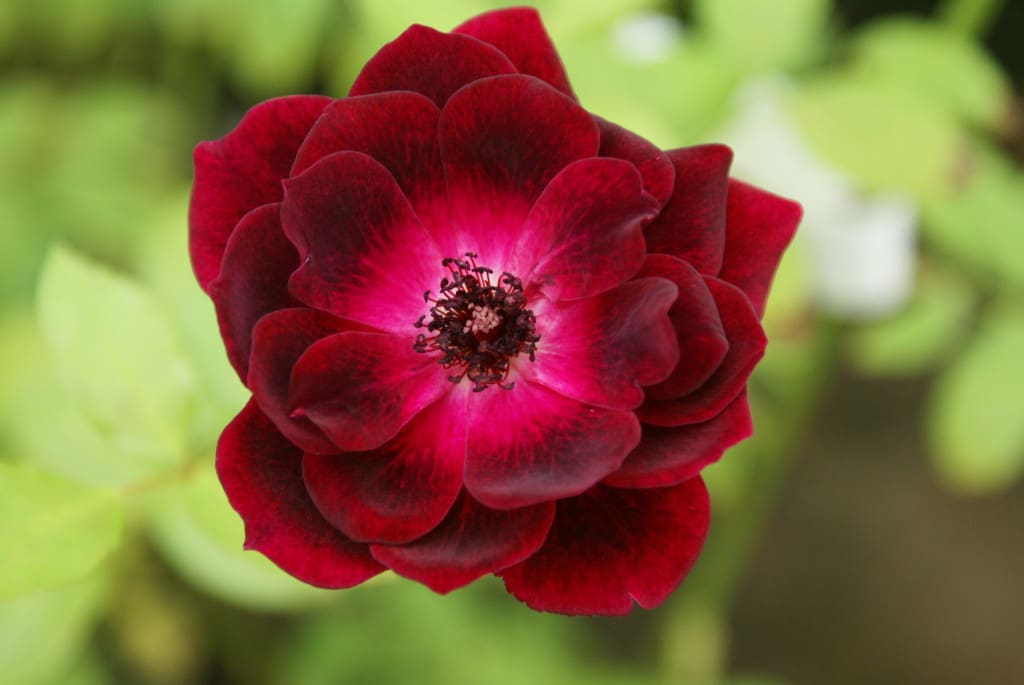

Exactly like ‘Iceberg’ in growth habit & flowering ability. Clusters of burgundy-red blooms with a silver reverse. It has become a favourite in South Africa & is the ideal choice for contrasting with ‘Iceberg’.
Free State Stockists:
Greenside Kwekery – Bloemfontein
Urth Garden Centre – Bloemfontein
Gauteng Stockists:
KwaZulu-Natal Stockists:
Blackwood’s Home of Gardening – Pietermaritzburg
Garden Pavilion Halls – Kingsburgh
Ludwig’s Star Roses – Hillcrest
Limpopo Stockists:
Mpumalanga Stockists:
Garden Pavilion – White River
Ninfa Tuinsentrum – Middelburg
North West Stockists:
Garden Pavilion – Geelhout
Sittig’s Nursery – Hartebeespoort
Western Cape Stockists:
Ludwig’s Roses Winelands – Stellenbosch
Stodels – Bellville
Stodels – Constantia
Stodels – Kenilworth
Stodels – Milnerton
Stodels – Somerset West
**Please note that not all stockists will have every plant featured**
Chives
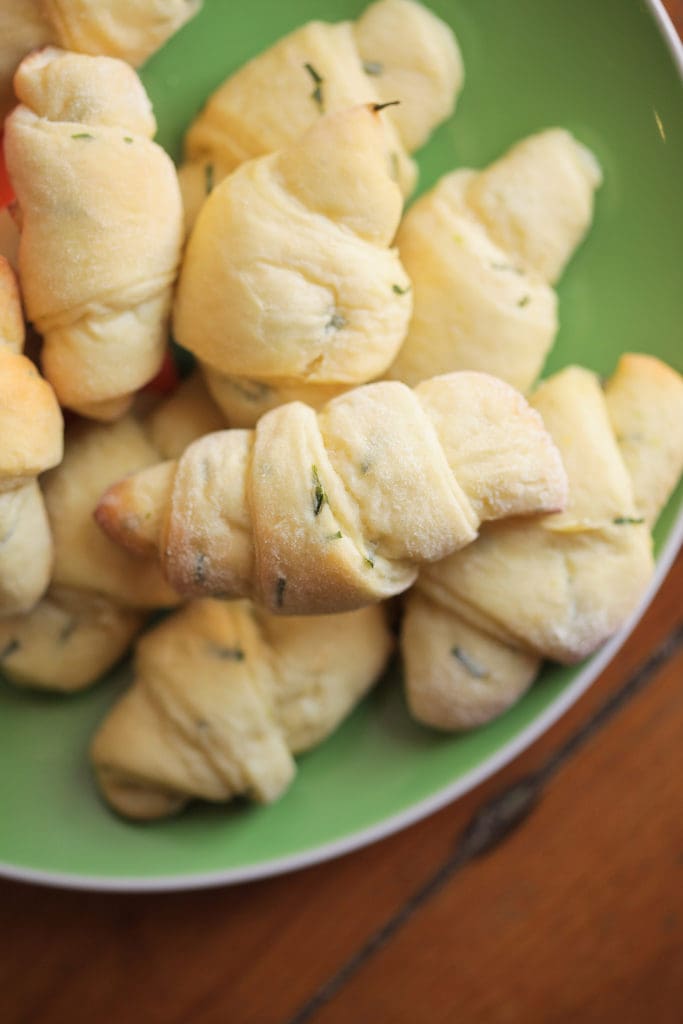
Chives (Allium schoenoprasum) are members of the Allium family, along with garlic, leeks, onions, scallions and shallots, but with a mild onion flavour. They are all effective in countering infections, including those of the nose, throat and chest, although garlic is by far the most effective. Chives have similar medicinal properties, just not as potent. Nevertheless they are rich in vitamins A and C, as well as calcium and iron. Like parsley, adding one or two tablespoons a day to the diet takes very little effort.
Garlic Chives (Allium tuberosum) are grown for their mild garlic flavour. While not as powerful as garlic, they do act as a tonic and blood cleanser.
Growing
 Chives are perennial, growing 25cm high and 20cm wide. In frost areas, they do go dormant and die down in winter, and come back again in spring. It is one of those cut-and-come-again herbs. Chives grow easily from seed and do best in full sun, but will grow in partial shade, in well-drained, composted soil.
Like spring onions, chives also form clumps but only the leaves are harvested (by cutting them off at the base). New shoots emerge quickly. If fed with liquid fertiliser at half the recommended strength once a month new leaves will be produced for two to three years.
Dividing
Divide the plants or sow new seed when they lose their vigour. Thick clumps of chives and garlic chives can be divided and replanted in Autumn into freshly composted soil. If you have enough to go around, pot up a few pots too. Keep them on a sunny kitchen windowsill in winter. The soil must be kept moist and your chive pots should be fed regularly with a liquid, indoor plant fertiliser.
What you do
- Lift or dig up a mature clump.
Capsicum Varieties – Chillies


Turn up the heat with ornamental peppers!
Capsicum varieties are ‘hot, hot, hot’ and include sweet peppers, cayenne peppers, ornamental & seriously real chillies. The taste and ‘heat’ of peppers varies according to varieties – jalapeno chillies are medium to hot & cayenne peppers are seriously hot. The selection of different shapes, sizes and colours of ornamental peppers is constantly on the increase. Capsicums offer a small, long lasting indoor pot option that is fun, vibey AND edible!
Much like hot peppers grown in the veggie garden, ornamental peppers produce colourful small fruit provided they get enough sunlight. Many ornamental capsicums are grown for purely ornamental purposes, as they are largely unpalatable.
Depending on the variety, the peppers appear in shades of white, purple, red, orange, and yellow – often with multiple colors on the same plant. They like rich, well-drained soil and are thirsty plants – be sure to keep the soil moist and don’t allow the plants to dry out.
Capsicums are most commonly grown in the kitchen on sunny windowsills alongside other edible herb varieties. They can however be successfully positioned in any sunny indoor location and should ideally be out of gusts and drafts.
Position: Chillies need a high light position when kept indoors. They perform well outdoors in a full sun location, both in pots or planted out in the garden.

Watering: The soil should be kept moist at all times. When kept indoors water every 2nd day with approx. 2 tablespoons (or ice cubes) of water. Plants in outdoor containers require more regular watering to prevent the soil from drying out.
Additional care:
- Chilli plants are annuals – ie. they only last for one season
- Promote and enhance the colour and flavour intensity, as well as the duration of the fruits with regular foliar feeding
- In outdoor areas with limited air movement, they are susceptible to white fly, so opt for a well ventilated position if possible
Victoria Blue salvia

Victoria Blue salvia plants reach 18-24 inches tall, with a similar spread, at maturity. The deep blue flowers run up and down flower spikes that are commonly as long as 8 inches, thereby giving them significant “pop” in a landscape design. The foliage is also attractive, being a grayish-green; the leaves are lance-shaped. This type of ornamental sage can be made to bloom all summer long with proper care
Stockists Kwa-Zulu Natal:
Blackwood’s Home of Gardening
Builders Warehouse – Riverhorse
Garden Pavilion Halls – Kingsburgh
Hingham Nursery – Durban North
Illovo Nursery – Kingsburgh
Builders Express – Amanzimtoti
Builders Express – Ballito
Builders Express – Hillcrest
Builders Express – Pietermaritzburg
Builders Express – South Coast
Builders Express – Umhlanga
Builders Warehouse – New Castle
Builders Warehouse – Durban North
**Please note that not all stockists will have every plant featured**
A1 Water Wise Poster for November: One-Drop Plants (Cape May)

Eleventh in a series of water wise plants to plant in the garden.
Preview
Agapanthus
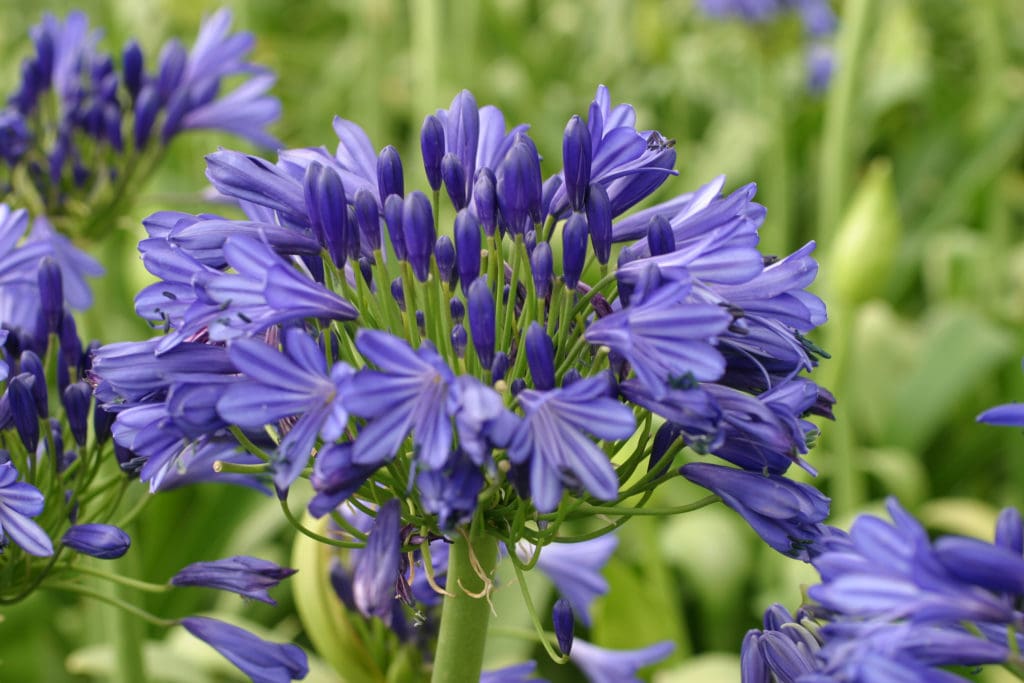 Perennial garden hybrid
How to see who has liked your business Facebook page

A video describing how members can see exactly who has like their business Facebook pages
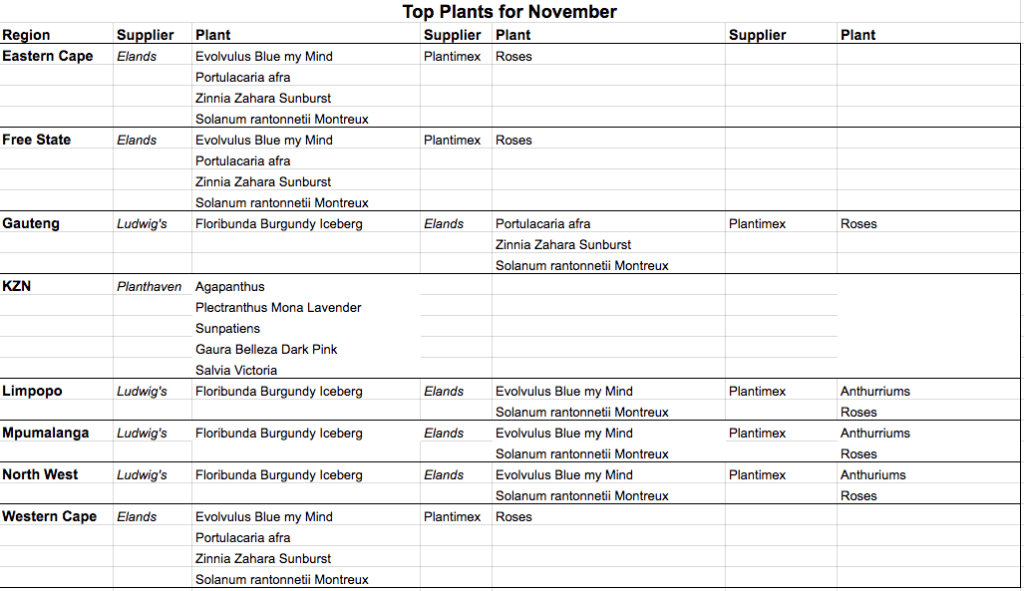
Top Plants for November
Preview
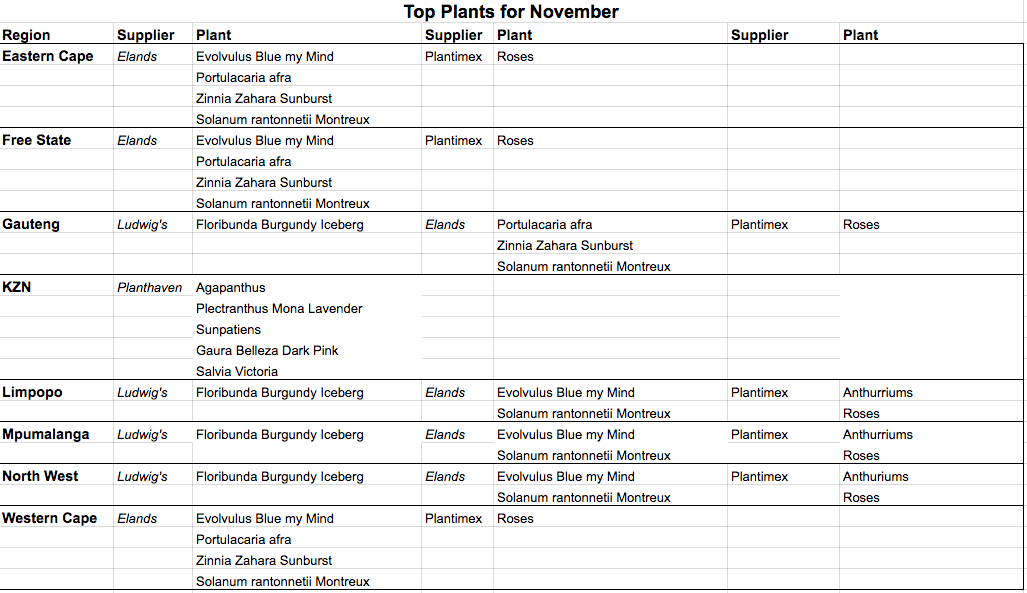
A list of the top plants per region, for November, to order for your garden centre
Download here!
Report: Gardening for The Sunflower Fund Campaign
 A break-down on "Gardening for The Sunflower Fund"
How to Sow Seeds Read more here
 Read more here
Bountiful Basil

 To experience one of nature’s most delicious perfumes, just bury your nose in a handful of freshly picked basil leaves.
The fragrance and flavour of basil has made it one of our most popular culinary and household herbs. It also has many health benefits, especially as a cleansing tonic for the system. There are now so many different types of basil and what fun it is to experiment with the new varieties and new tastes in addition to the culinary stalwart sweet basil – Ocimum basilicum.
Growing basil
All basils are equally easy to grow; they prefer morning sun in hot areas and full sun in cooler areas. Basil does best in fertile, well composted soil that drains well. The basils need more water than other Mediterranean herbs so should be watered regularly, the best time being in the morning. Monthly feeding allows them to produce lush leaves and pinching off the growing tips of small plants encourages bushy growth. Annual basil and some perennial varieties are frost and cold sensitive, while the perennial pink basil and sacred basil will survive winter if planted in a sheltered, sunny part of the garden.
Basil is a good companion plant for tomatoes, reputedly increasing the flavour of the fruit and promoting healthy growth. It also helps repel aphids, white fly, fruit fly and beetles.
Sowing basil
Basil germinates easily and is quick to grow from seed, but should only be sown after all danger of frost has passed.
- Prepare the bed by digging in extra compost, rake it level and remove stones and sticks.
- Seed can be sown in rows or scatter sown at a depth of 3mm. Lightly firm down the soil and water gently.
- Keep the soil moist until germination, which usually occurs within seven days.
- Thin out plants until the final ones are 30 cm apart.
Wicker Wonderful
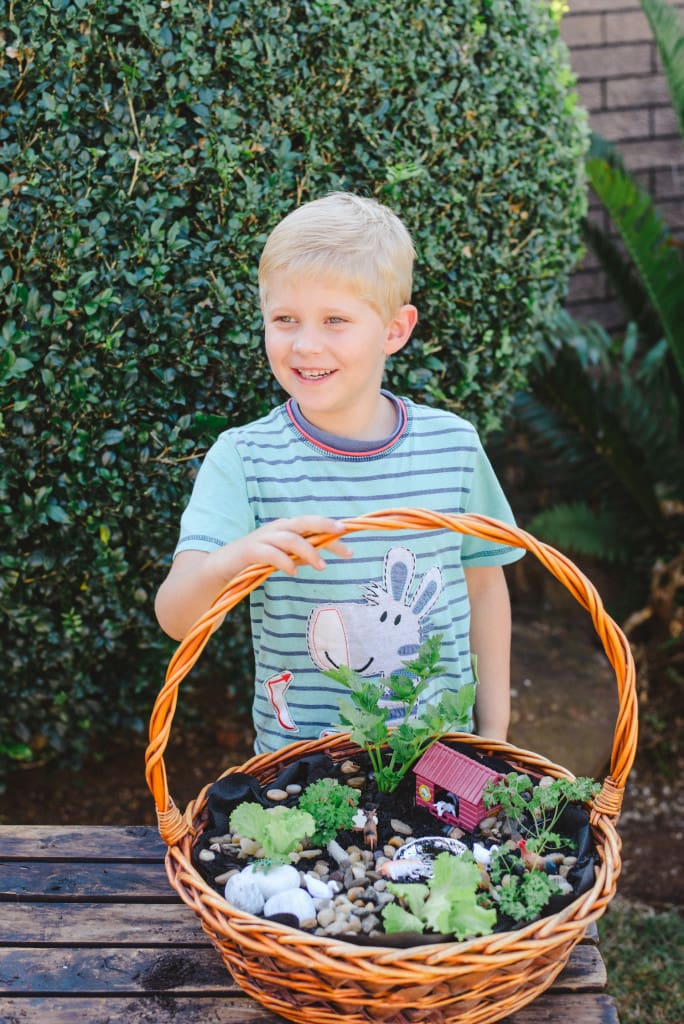
Spring is such a happy season - it’s when the garden starts to come to life again after Winter and the kids can enjoy being outside once more. With the sun out and the weather warming up, this is a perfect time to get creative with the kiddies to build their very own outdoor farmyard.
Before you start thinking: “oh no, what a mess” - we don’t mean a ‘real’ farmyard, but a mini one, which is neat and will look cute in any garden. The kids will really enjoy this project and you can use as many different farmyard elements as you like.
Ok, let’s stop horsing around and get to the good part.
What you will need:
 - An old/reusable wicker basket
- Drip tray to fit in the bottom of the basket
- Weed barrier cloth
- Potting mix
- Plants
- Farmyard animals and toys
- Watering can
- Baby decorative stones and some bigger ones
- Gherkin bottle lid wrapped in some foil (to look like a watering trough for the farm animals)


Indoor Plant of the Month for October – New Guinea Impatiens


It’s hard to find striking colour contrasts as unique and vivid as New Guinea Impatiens. These hardy, easy-to-grow impatiens thrive in half sun/half shade locations and can be used to brighten up indoor spaces for several weeks at a time.
New Guinea impatiens have much larger flowers than the common bedding plant impatient. The colour combinations are endless, both in the blooms and foliage which may vary from variegated to tri-colour. Flower petals are typically vivid and striking, from stark white to multi-shaded pinks, blush and crimson – New Guinea impatiens are ‘big’ on colour!

New Guinea impatiens are excellent container specimens suited to both individual and mixed plantings. They are a warm season crop and sun-loving, typically available in garden centres from August through to April/May. New Guineas are grown as perennials outdoors (in frost free areas) and are often brought into the home when flowering. They offer a striking, indoor plant that will brighten a room and add bold colour when entertaining. Flowering indoors last for up to 3 – 4 weeks. They can be grown indoors indefinitely, but in order to flower, need sunshine. We recommend alternating pots, positioning the New Guinea’s on a sunny verandah or window sill when not in full bloom.
New Guinea impatiens are disease resistant, bushy and compact. They offer a stunning, low maintenance indoor option – albeit just for a few weeks at a time.
Position: In a sunny location indoors, close to windows and bright light. When planted in the garden, allow for either morning or late afternoon sun. Half sun/half shade locations for containers and hanging baskets.
Frost sensitive
 Watering: New Guinea impatiens are thirsty plants requiring regular watering. They are quick to wilt, so watch your plants and adjust the watering frequency accordingly. Drainage is essential, so do not allow container plants to get wet feet.