Hedging your bets
A good boundary planting does far more than mark where one property ends and the next begins. It softens hard walls, filters wind and dust, muffles traffic and gives birds, bees and butterflies a place to feed and shelter. When the plants are indigenous, the screen settles in with less water, fewer pests and much less fuss than the exotic hedges that have lined suburban streets for decades.
Spring is the time to get these screening shrubs into the ground. The soil is warm and young plants respond with a flush of soft new growth that can close surprising gaps in a single season. In summer-rainfall regions, the coming rains do much of the watering, and a hedge planted now has the whole growing season to root in before the dry months return. Gardeners in the winter-rainfall Western Cape often favour autumn planting, but spring works there too with regular watering.
The screening shrubs below are hardy, quick to fill out and easy to find at nurseries that stock indigenous plants. Between them, there is something for coastal gardens, frosty Highveld plots, security-minded boundaries and narrow side passages.
1. Plumbago (Plumbago auriculata)
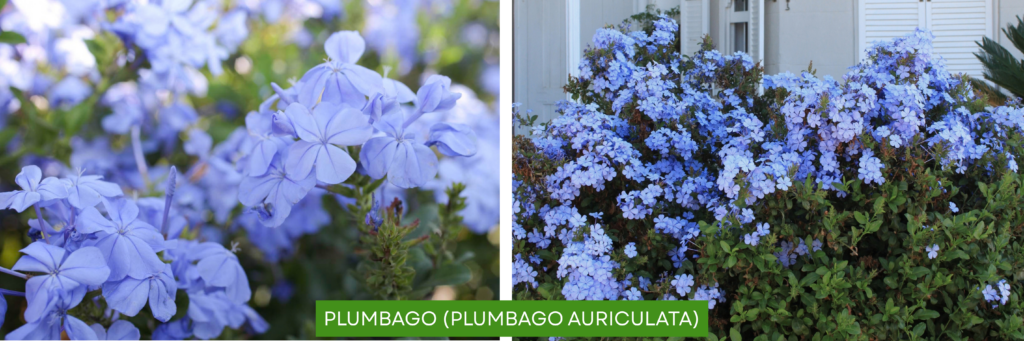
Few shrubs say ‘South African garden’ quite like plumbago. Its sky-blue flower heads appear from spring right through to autumn, and a white form is available for those who prefer something softer against a painted wall. It grows quickly into a loose, scrambling shrub (2-3 m tall) and takes hard pruning without complaint, so you can keep it as a tidy hedge or let it tumble over a fence.
Plumbago is tough in heat and drought, and while heavy frost will knock it back, it usually resprouts once the weather warms. It is also a larval host plant for small blue butterflies.
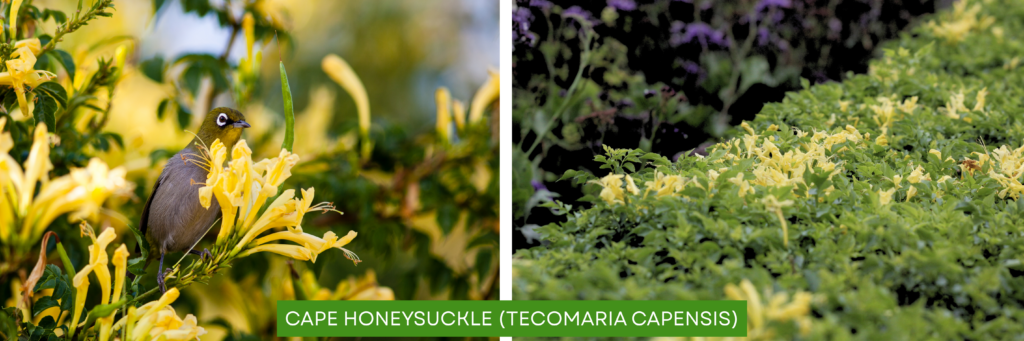
2. Cape honeysuckle (Tecomaria capensis)
Cape honeysuckle is a lifesaver for anyone who needs cover in a hurry. It is one of the fastest-growing shrubs on this list, sending out long, arching stems that knit together into a dense screen (2-3 m tall), and it will climb higher if given a wall or fence to lean on. The glossy, divided leaves look fresh all year.
The bright orange tubular flowers appear mainly from late summer into winter, with flushes at other times, and sunbirds treat a flowering hedge like a fuel stop. It does need regular trimming, as those enthusiastic stems will happily wander into a neighbour’s garden.

3. Kei apple (Dovyalis caffra)
Where privacy and security go hand in hand, the Kei apple is hard to beat. Its branches carry long, sharp spines (40-70 mm), and when the plants are spaced closely and pruned regularly, the stems mesh into a barrier that very few people or animals would try to push through – a great security plant. Left alone, it grows into a small tree (3-5 m tall), but regular clipping keeps it compact and thick.
There is a bonus too. Male and female flowers grow on separate plants, so a hedge of several shrubs usually includes both, and the females bear round, golden fruit with a tart, apricot-like flavour that makes excellent jam. Kei apple is very hardy, grows in full sun or light shade, and copes with both drought and frost.
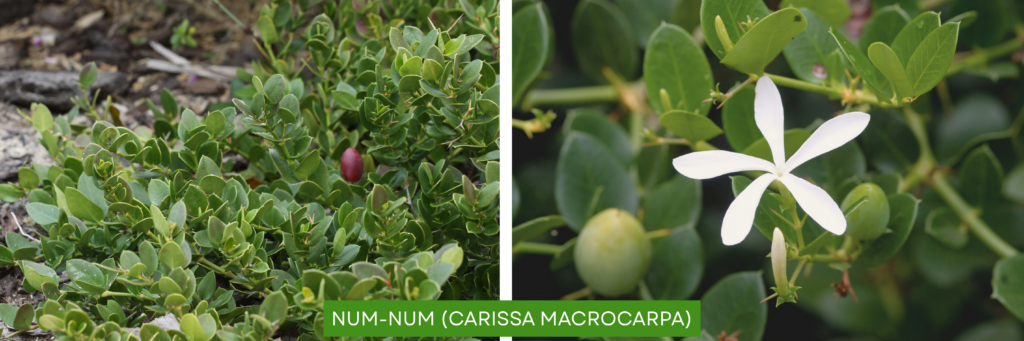
4. Num-num (Carissa macrocarpa)
The num-num is a coastal gardener’s friend. Its thick, glossy leaves shrug off salt spray and wind, and its forked thorns give it a useful protective edge without the sheer ferocity of the Kei apple. It forms a dense, rounded shrub (2-4 m tall) that clips beautifully into a formal hedge.
The starry white flowers have a sweet scent that drifts across the garden on warm evenings, followed by plum-red fruit that is lovely fresh or cooked into jelly. Num-num is frost tender, so it is best suited to warm coastal and subtropical gardens such as those in KwaZulu-Natal and the Eastern Cape.
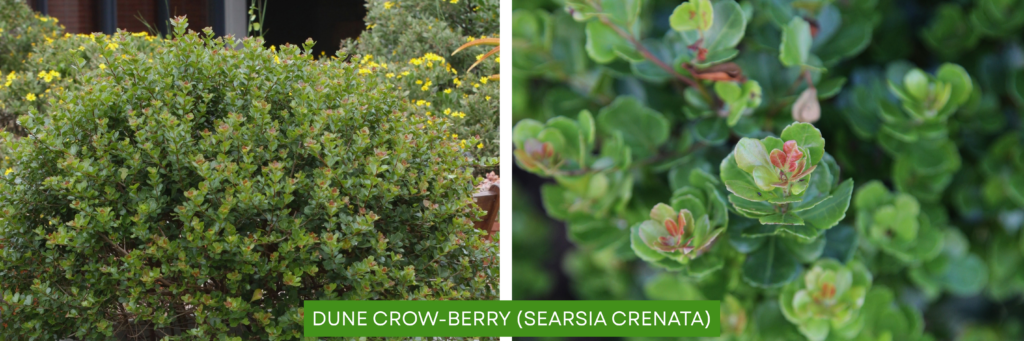
5. Dune crow-berry (Searsia crenata)
Anyone gardening on sandy soil within reach of the sea should take a look at the dune crow-berry. It occurs naturally on coastal dunes from the Cape Peninsula to southern KwaZulu-Natal, so wind, salt and poor sandy soil are its natural conditions rather than a problem to overcome. It is a good sand binder and an effective windbreak, which makes it ideal for exposed boundaries.
The small, glossy leaves have neat scalloped tips, and the shrub is naturally dense and multi-branched (up to 3 m tall). Small cream flowers in autumn are followed by dark berries that draw birds in numbers. Once established, it is water-wise and tolerates light frost.
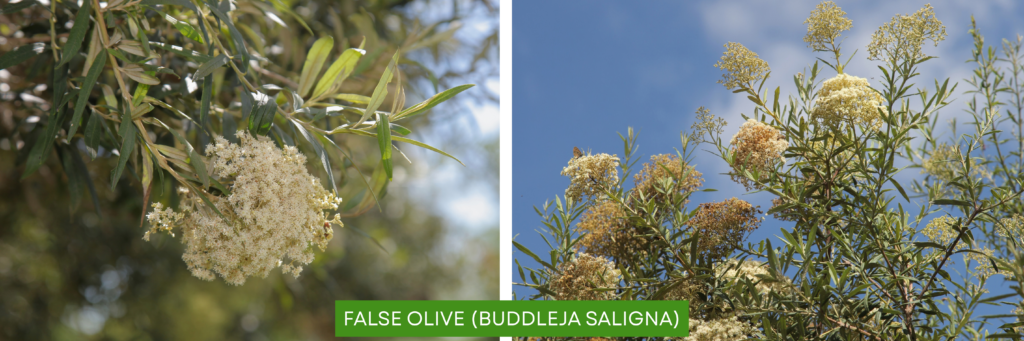
6. False olive (Buddleja saligna)
For colder inland gardens, the false olive is a reliable backbone plant. It is fast-growing, evergreen and tolerant of both frost and drought, which makes it a good fit for the Highveld. The narrow, olive-like leaves are dark green above and pale beneath, so the whole shrub has a soft, silvery shimmer when the wind moves through it.
In spring and early summer, it is covered in sprays of tiny, creamy-white flowers with a honey scent, and the hedge hums with bees, butterflies and other insects. Left to its own devices, it becomes a small tree, but with regular pruning it makes a thick, informal screen (2-4 m tall).
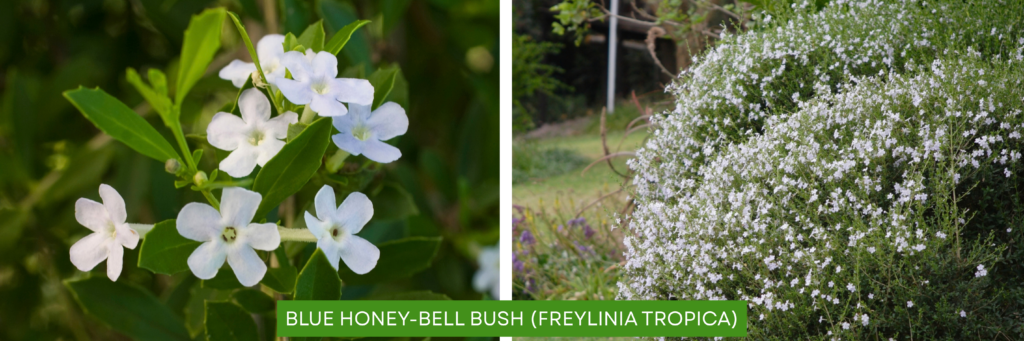
7. Blue honey-bell bush (Freylinia tropica)
Not every boundary is a wide, open space. Side passages, narrow beds alongside a driveway and the strip between a house and a wall all need something slim and upright, and this is where freylinia shines. It grows quickly to about 2 m but stays narrow (around 1 m wide), and it responds so well to clipping that it has long been used for hedging.
Its main show is in spring, when the slender branches are covered in mauve-blue bells, with lighter flowering through the warmer months. For a formal hedge, space the plants closely (75-100 cm apart). It prefers semi-shade, compost-rich soil and regular water, and does best in summer-rainfall gardens.

8. Sand olive (Dodonaea viscosa)
The sand olive is a true pioneer. It establishes quickly in difficult spots, tolerating wind, drought, poor soil and frost. It grows into a dense shrub (2-4 m tall) in a short time. The narrow, slightly sticky leaves have a fresh green gloss. In summer the shrub carries papery, winged seed capsules that turn from pale green to rosy brown.
Because it is so quick, the sand olive is often used as a nurse plant, filling a boundary while slower shrubs build up behind it. It is equally at home in coastal and inland gardens.
Planting for a quick, dense screen
The trick to a hedge that fills in fast is good preparation. Rather dig a continuous trench than individual holes. This allows the roots have loose soil to spread into along the whole length of the boundary. A trench (40-50 cm wide and deep) with plenty of compost worked into the soil gives young plants an excellent start.
Spacing depends on the shrub and on how quickly cover is needed. Most of these plants make a dense hedge when set fairly close (60-100 cm apart). Planting a double row in a staggered zigzag closes gaps sooner than a single straight line. Water deeply after planting and two or three times a week for the first month. Gradually reduce watering as the plants establish. A layer of mulch (5-7 cm deep) keeps the roots cool and holds moisture through the hot months ahead.
The secret most gardeners skip is early pruning. It feels wrong to cut back a young plant that is meant to grow tall, but pinching out the tips in the first season encourages side shoots and builds density from the base up. A hedge that is allowed to race upwards unchecked often ends up bare at the bottom. When shaping, keep the base slightly wider than the top so that sunlight reaches the lower branches.
Layering for a more natural boundary
A single-species hedge has a clean, orderly look, but there is another way. In nature, the edge of a forest is never one plant deep. Taller shrubs and small trees stand at the back, medium shrubs fill the middle, and groundcovers and perennials knit along the front. Copying that pattern creates a boundary that feels as if it has always been there.
Think of it as casting a production. A tough, evergreen plant such as Kei apple, false olive or dune crow-berry plays the supporting role at the back. It will also provide year-round structure. The flowering shrubs, plumbago, Cape honeysuckle and blue honey-bell bush, take the leading roles in front. They each have their moment in a different season. Group plants in odd numbers (three, five or seven). Repeat those groupings along the boundary to give the planting rhythm. This allows the eye moves along it comfortably instead of jumping from one shrub to the next.
Mixing species also means that if one plant struggles, the screen does not fail. A varied boundary feeds birds and insects right through the year.
A boundary is one of the largest plantings in any garden, so it deserves some thought. Choose two or three of these shrubs that suit the conditions. Get them in while the soil is warm, and enjoy watching the gaps close as the season moves on.