
Coffee (Coffea Arabica)


Arabica Coffee is a species of coffee originally indigenous to the forests of the Ethiopia. It is also known as the “coffee shrub of Arabia”, “mountain coffee”, or “arabica coffee”. It is believed to be the first species of coffee to be cultivated.
We have 2 varieties of Arabica:
1) Bourbon with a red berry with excellent cup quality
2) Catuai is high yielding
Clusters of white flowers
Fruit bearing for coffee production
Shade –semi shade and sun in mild climates
Evergreen
Full Sun
Gauteng Stockists
Lifestyle Home Garden – Randburg
Limpopo Stockists
Mpumalanga Stockists
**Please note that not all stockists will have every plant featured**
What to do about Cypress aphids on your conifers

Symptoms
Our “gogga” of the month for May, Italian Cypress (or conifer) aphids, will leave sooty mould and stickiness (honeydew) and yellowing foliage on conifers
What does this mean for me/my plants?
Suggested Action
Active from May to September. Damage can only be seen after the end of the winter season. Apply systemic granular or liquid insecticide every two weeks. Drench the soil if liquid formulation is used, or spread around the plant, in the ground and water well. Cypress aphids cannot be seen with the naked eye and damage is always seen too late. Preventative treatment is recommended from May to September. To note – Cypress aphids attach from inside to outer leaves. Must not be confused with fungal damage – fungal damage normally occurs from the outer leaves inwards. Visit your local GCA Garden Centre for advice on how to treat conifer aphids!
Sexy Spinach

Sexy spinach is not only full of flavour, but full of goodness too! It’s high in iron, Vitamin A, Vitamin C and is low in calories – so good for the waistline too 😉 What most of us eat as spinach is usually Swiss chard because it is so much more available, being easier to grow, heat tolerant and more productive. The Swiss chard varieties are ‘Fordhook Giant’ which has dark green leaves and broad, white midribs, ‘Lucullus’ which has long, light green leaves, and ‘Bright Lights’ which has red, yellow or orange midribs and dark green leaves.
Growing
Swiss chard and spinach are among the easiest vegetables to grow. They germinate easily, don’t take up much space and are easy to harvest. But, they are gross feeders and if you want to harvest on a continual basis regular feeding is the secret for success.
- Prepare and enrich the soil before planting with generous amounts of organics as well as bonemeal for root development.
- Both vegetables can be sown in situ. Swiss chard can also be sown in seed trays as it transplants better than spinach.
- Keep the soil moist during germination – about five days.
- Seedlings should be spaced, or thinned out, to about 20cm apart.
- Feed with a liquid fertiliser about two weeks after germination and once a month after that, or more frequently if you are harvesting regularly.
- Succession planting is recommended (this means planting another crop in the same space once the first crop has been harvested).
Harvesting
One of the most compelling reasons for growing your own spinach is that it wilts so quickly and shop bought produce cannot match the quality of freshly picked leaves. Leaves should be ready for picking about 8 weeks after sowing. They can be cut or twisted off at the base of the plant.
May in the Garden

The mild month of May is a perfect time to add new plants to your autumn garden. Plant some winter and spring beauties on ‘Workers’ Day (you will be at home on the public holiday on 1 May!) and see how smart plants can ‘work’ for you in the seasons to come…
Trending – ‘Colour blocking’
 Colour blocking is a fashion trend which originated from the artwork of Dutch painter, Piet Mondriaan. He used clean, and simple lines, and solid colours opposing each other on the colour wheel. This trend works very well in the garden too, if you plant bold patches of opposing, but complementary colour combinations. An example: blue delphiniums paired with bright orange calendulas. You can even add a little grey in there by using bold swathes of silvery grey sedge grass (Festuca). Midnight blue and bright yellow is another good combination and you can do this by planting a mass of dark blue pansies set off by bright yellow violas. If you’re not sure about this concept, visit a top GCA garden centre’s seedling tables and flowering perennial displays (many indigenous daisies, diascias and nemesias are flowering now), where you will clearly see which colours go together well. Colour blocking doesn’t stop with plants – you can paint a background wall in a contrasting, but complementing colour, to the plants near it.
Spoil mom!
Mother’s Day is on Sunday 13th May. As moth orchids (Phalaenopsis) are always available in bloom and stay that way for months on end, why not spoil your mom or grandma with a beautiful specimen to keep her company with its floral elegance throughout winter? You will find the widest variety and healthiest specimens at your nearest GCA garden centre. They will also have smart cover pots in stock to display it in.
A1 Edibles Poster – May 18: Swiss chard

A1 Poster for edible gardening in May 2018, Swiss chard, for your garden centre
Preview
A1 Poster – Benefits of Gardening #2

Second in the 3-set series of A1 posters, detailing the “Benefits of Gardening”, for your garden centre
Preview
Bonsai Basics: How to fertilise your bonsai Watch here!
 Watch here!
Top Plants for May
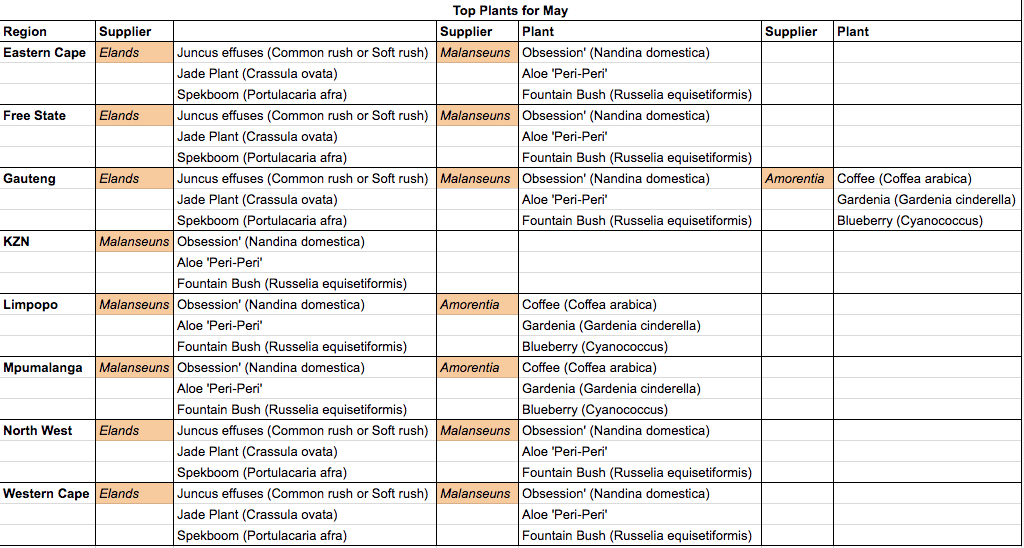
A list of the top plants per region, for May, to order for your garden centre
Preview

Download here!
Water Wise Watch: Apr 2018


This month at Water Wise
"Autumn is here"
This year is absolutely flying by and I can't believe we are already into Autumn and moving quickly towards winter! Be sure to start preparing your garden for the first winter frost now. Most important is to ensure that all your frost-sensitive and vulnerable plants are protected when the first cold hits. Frost netting or hessian works well to protect tender plants. Don't forget to use mulch. Mulch is a wonderful 'all-rounder' in any garden, keeping the soil moist and cool in summer and acting as a blanket in winter. It is very Water Wise! Now is also a great time to plant winter seedlings such as violas, pansies, petunias, and primulas. You can also prepare your winter veggie garden by looking at planting cabbage, cauliflower, parsnips and broad beans. Fast-growing greens such as lettuce and spinach will work well now.
Autumn is also a great time of the year to fill your beds with rich, dark compost to ensure your soil is filled with nutrients before winter. Remember, you can enjoy your garden all year through!

International Earth Day
We also celebrate International Earth Day this month. Earth Day is the world's largest environment movement and will be celebrated on 22 April this year. The theme for this year's campaign is 'End Plastic Pollution':"From poisoning and injuring marine life to disrupting human hormones, from littering our beaches and landscapes to clogging our waste streams and landfills, the exponential growth of plastics is now threatening the survival of our planet. In response, Earth Day 2018 is dedicated to providing the information and inspiration needed to fundamentally change human attitude and behaviour about plastics."
For more on this campaign, please visit www.earthday.org.

This month with Water Wise

BirdLife South Africa together with Rand Water (Water Wise), Department of Environmental Affairs, Joburg City Parks and Zoo and the Rare Finch Conservation Group officially launch the 2018 Flufftail Festival at the Johannesburg Zoo on 20 April 2018.
What to do about termites in your garden


Symptoms
Our “gogga” of the month for April, termites, will leave ulcerous-looking nests and blowholes on trees
What does this mean for me/my plants?
Once ring-barking (the removal of a strip of wood on the branch or stem by termites) has occurred, the plant will die if left untreated, as nutrition will no longer reach the plant’s roots.
Suggested Action
Apply a systemic insecticide with fumigating properties, for control of wood destroying termites, or a granular bait for harvester termites (the latter found on lawns only). Harvester termites have now become an all year round problem. Note: Be careful not to confuse lawn eating termites and wood eating termites. Visit your local GCA Garden Centre for the best solution!
Ideal for Indoors in April – Peace in the Home Sometimes we all just need a little PEACE & QUIET…
 Sometimes we all just need a little PEACE & QUIET…
Get creative in the garden with a teepee trellis

What you will need:
- Some dowelling rods
- Some string
- Mandevilla seedlings
- Budding tape or cable ties
- Scissors
- A spade
- A rake
- Some bonemeal, a handful of fertiliser and half a bag of compost, in a Trug or wheelbarrow


A1 Poster: Ideal for Indoors – ‘Peace in the Home’

A1 Ideal for Indoors poster for your garden centre
Preview
Amazing Antirrhinums (Snapdragons)


Most of us have childhood memories of squeezing the flowers of Antirrhinums together to make dragon mouths. Stunning snapdragons are not only an endless source of amusement to children, they are ideal for bringing striking colour into the garden.
While antirrhinums can be grown throughout the year in most parts of the country, March, April and May are ideal months to plant out the seedlings. They have just enough time to settle themselves in before the depths of winter, readying themselves for a glorious spring and early summer display. Snapdragons tolerate light frost so you can still plant these delightful beauties if you live in one of the colder parts of the country.
Antirrhinums are easy to grow in any well-drained, reasonably fertile, garden soil, but prefer a light or medium loam – so add in plenty of compost when preparing the bed. The soil needs to be kept relatively moist, so water deeply every 5 days or so. They like a warm, sunny location, but in a hot climate they perform better in partial shade. Put the plants where they will receive good air movement to prevent the fungal disease or rust taking hold.
April in the Garden

It’s April gardening – spring bulb planting time, and school holidays again. Put the kids to work and play, with you in the backyard this Easter.
Smart planting!
GCA garden centres across the country report that the following plants are on their top-selling hit parade in autumn. You can’t afford to miss out!
- Aloe hybrid ‘porcupine’ – a compact aloe with striking bi-coloured flowers in deep rose pink and greenish cream shades, peaking in autumn. Perfect for hot rock gardens or pots.
- Abelia x grandiflora ‘Kaleidoscope’ – a compact hybrid of an old favourite with bright variegated foliage. Perfect for low hedging.
- Crown of Thorns (Euphorbia milii) – spiny succulent with sparse leaves and bright flower bracts. Available in a variety of different colours. Drought tolerant, and perfect for pots too.
- Angel wings (Gaura ‘Rosy Jane’) – a desirable perennial with delicate, two-tone pink and white flowers. A new form of an old gardening favourite!
- Horseshoe pelargonium (Pelargonium zonale) – the indigenous specie grows into a wild woody shrub, flowering in pink all the time. Modern hybrids will shower you with colour in every shade. Great for beds, window boxes, and pots.
- Ribbon bush (Hypoestes aristata) – masses of attractive lilac pink flowers on an indigenous shrub which likes to grow in the dry shade of trees.
- Everlasting (Syncarpha argentea) – silvery foliage on a dainty plant, supporting small, paper-like flowers in soft pink and white. Perfect for pots too.
- Hairawn muhly (Muhlenbergia capillaris) – grass with spectacular and billowing inflorescences of masses of vibrant pink, airy flowers on tall stems. This grass tolerates poorly drained soil but also drought conditions. Perfect for meadow planting.
A digging patch
If we don’t make time to teach the young folk to love gardening, who is going to plant trees, flowers, fruit and vegetables one day.
A1 Poster – Now Trending

A1 poster detailing the “Now Trending” item Upcycling, for your garden centre
Preview

SANA Marketing News: March 2018

Your one-stop link for news in March 2018!
Click here to read the First Marketing Newsletter for March

Click here to read the Analytics and Publicity Report for March
SANA Marketing News: February 2018

Your one-stop link for news in February 2018!

Click here to read the First Marketing Newsletter for February
Click here to read the Analytics and Publicity Report for February
SANA Marketing News: January 2018

Your one-stop link for news in January 2018!
Click here to read the First Marketing Newsletter for January

Click here to read the Analytics and Publicity Report for January
SANA Marketing News: December 2017

Your one-stop link for news in December 2017!
Click here to read the First Marketing Newsletter for December

Click here to read the Analytics and Publicity Report for December